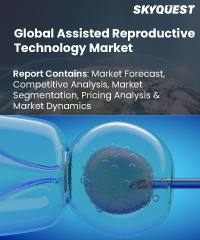
Assisted Reproductive Technology Market
Report ID: SQMIG35A3061
Report ID: SQMIG35A3061
sales@skyquestt.com
USA +1 351-333-4748
Report ID:
SQMIG35A3061 |
Region:
Global |
Published Date: July, 2025
Pages:
197
|Tables:
63
|Figures:
69





Global Assisted Reproductive Technology Market size was valued at USD 38.9 Billion in 2024 and is poised to grow from USD 42.13 Billion in 2025 to USD 79.73 Billion by 2033, growing at a CAGR of 8.3% in the forecast period (2026–2033).
The assisted reproductive technology market is witnessing significant growth driven by rising infertility rates, increasing awareness of reproductive options, and advancements in medical technologies.
The current advancements in ART technologies such as improved genetic screening, embryo culture methods and diagnostic instruments have been raising the efficacy and success rates of therapies.
Various organizations, such as the American Society for Reproductive Medicine and the Society for Assisted Reproductive Technology (SART), are working together to increase awareness about infertility treatment options.
Furthermore, several innovative types of research are undergoing in the field of culture media for ART. For instance, CooperSurgicals found that culture media with Granulocyte-macrophage Colony-Stimulating Factor (GM-CSF) contains essential nutrients required for embryo development and further enhance the transmission between the embryo and the endometrium, developing the essential environment for the pregnancy.
How is Artificial Intelligence Transforming the Assisted Reproductive Technology Market?
Artificial Intelligence (AI) plays a transformative role in the market by increasing accuracy, improving the success rate, and optimizing clinical decisions. AI is used in different stages of fertility treatment, ranging from fetal choices and semen analysis to IVF success prospects. By analyzing the huge dataset for the patient profile and treatment results, AI helps embryologists identify the healthiest embryos and recommend individual treatment protocols, which significantly improves the possibility of conception.
Market snapshot - 2026-2033
Global Market Size
USD 35.92 Billion
Largest Segment
In-Vitro Fertilization (IVF)
Fastest Growth
Artificial Insemination
Growth Rate
8.3% CAGR
To get more insights on this market click here to Request a Free Sample Report
Global assisted reproductive technology market is segmented by type, end-use, and region. Based on type, the market is segmented into in-vitro fertilization (IVF), artificial insemination, and others. Based on end-use, the market is segmented into fertility clinics, hospitals, and others. Based on region, the market is segmented into North America, Asia-Pacific, Europe, Latin America, and Middle East & Africa.
How do Fertility Clinics Support Market Scalability?
As per the global assisted reproductive technology market outlook, fertility clinics are the dominant segment in the market. These specialized centers offer dedicated reproductive services such as IVF, IUI, egg/sperm donation, and fertility preservation. Their dominance is driven by the availability of advanced infrastructure, skilled embryologists, and tailored patient care. Fertility clinics often integrate the latest technologies, including AI-based embryo selection and genetic screening, to improve success rates. Their patient-centric models, streamlined procedures, and ability to handle large volumes of ART cycles contribute significantly to their leadership in the market.
As per global assisted reproductive technology market forecast, hospitals are emerging as the fastest-growing segment in the market. Many multispecialty hospitals are expanding their fertility departments to meet rising demand and to offer ART services as part of integrated reproductive healthcare. This growth is particularly notable in developing regions where hospitals are the first point of care for most patients.
How do Technological Innovations Strengthen IVF’s Market Position?
In-vitro Fertilization (IVF) is the most widely used and dominant segment in the market. Its dominance stems from its high success rates, technological advancements, and its ability to address a wide range of infertility issues in both men and women. IVF procedures benefit from innovations such as preimplantation genetic testing (PGT), intracytoplasmic sperm injection (ICSI), and AI-based embryo selection, which further improve outcomes. IVF is also increasingly used by single parents and same-sex couples, contributing to its broad application and leading market share globally.
As per global assisted reproductive technology market analysis, artificial insemination is the fastest-growing segment due to its affordability, lower invasiveness, and ease of administration. This procedure is often the first-line treatment for unexplained infertility or mild male factor infertility and is widely accessible in both public and private clinics.
To get detailed segments analysis, Request a Free Sample Report
What is Driving Growth of the Assisted Reproductive Technology Market in North America?
North America remains one of the leading regions in the market due to high awareness, favorable reimbursement scenarios, and widespread availability of advanced fertility clinics. The presence of skilled professionals, increasing acceptance of single-parent and same-sex family formations, and the rising age of first-time parents are key drivers in the region. Technological innovation and strong healthcare infrastructure further support ART adoption.
Assisted Reproductive Technology Market in the U.S.
The U.S. dominates the North America region, fueled by a high prevalence of infertility, increased demand for IVF and egg freezing, and a growing number of fertility centers. The country is also witnessing an uptrend in medical tourism, with international patients seeking access to state-of-the-art ART treatments. Regulatory support and increasing integration of AI and genetic testing are enhancing patient success rates.
Assisted Reproductive Technology Market in Canada
As per regional outlook, in Canada, the market is expanding steadily due to rising infertility rates and government support for select fertility treatments in certain provinces. Canada's progressive legal stance on same-sex parenting and surrogacy, along with growing public funding initiatives, is helping to make ART more accessible. The market is also benefiting from increased awareness and delayed family planning trends.
Why is Asia-Pacific the Emerging Hub for ART Services?
Asia-Pacific is experiencing rapid market growth due to population size, increasing cases of infertility, and evolving societal attitudes toward reproductive assistance. Many countries are investing in healthcare infrastructure and offering affordable fertility treatments, attracting medical tourism from both regional and international patients.
Assisted Reproductive Technology Market in Japan
As per regional analysis, Japan’s market is driven by one of the world’s highest average maternal ages and government initiatives to combat declining birth rates. Public subsidies for infertility treatments and growing investment in reproductive research are supporting ART growth. Clinics in Japan are also adopting AI to improve embryo selection and enhance IVF outcomes.
Assisted Reproductive Technology Market in South Korea
As per industry analysis, South Korea is proactively addressing its demographic challenges with strong government support for ART. The country provides subsidies for IVF and IUI, particularly for low-income families. Increasing social acceptance, improved treatment success rates, and public-private partnerships are accelerating the adoption of ART technologies.
How is Europe Advancing Ethical and Accessible ART Services?
Europe is a mature and regulated market, with widespread access to fertility services and robust government support in many countries. High healthcare standards, strong public awareness, and progressive laws regarding fertility treatments contribute to the market’s growth. However, regulatory variations across countries still influence patient access and treatment options.
Assisted Reproductive Technology Market in Germany
Germany maintains a strong market supported by quality clinical infrastructure and strict ethical guidelines. While some restrictions exist around embryo freezing and donor anonymity, technological innovation and increasing demand from older couples continue to support market expansion. Private funding and insurance are increasingly covering parts of ART procedures.
Assisted Reproductive Technology Market in the U.K.
The U.K. benefits from a well-structured ART framework regulated by the Human Fertilization and Embryology Authority (HFEA). Public awareness campaigns, NHS-funded fertility services in certain regions, and high clinical standards drive consistent market performance. The country is also a leader in embryo research and preimplantation genetic testing.
Assisted Reproductive Technology Market in Italy
Italy has undergone regulatory reforms in recent years, broadening access to ART services. Legal updates have increased eligibility for IVF and embryo cryopreservation. The demand is rising due to changing family structures, increased maternal age, and supportive private-sector clinics offering a range of advanced reproductive solutions.
To know more about the market opportunities by region and country, click here to
Buy The Complete Report
Assisted Reproductive Technology Market Drivers
Rising Infertility Rates Globally
Trend of Delayed Parenthood
Assisted Reproductive Technology Market Restraints
High Treatment Costs and Limited Insurance Coverage
Ethical and Legal Concerns
Request Free Customization of this report to help us to meet your business objectives.
The competitive landscape of the assisted reproductive technology industry is characterized by strong innovation, technological integration, and strategic expansion among key players. Leading fertility service providers and technology companies are focusing on enhancing clinical outcomes through AI integration, genetic screening, and automation of lab procedures.
As per market strategies, a notable example in 2024 is the strategic partnership between a global fertility clinic network and a reproductive AI startup to deploy AI-powered embryo grading and prediction systems across their clinics in Europe and North America. This collaboration aims to boost IVF success rates, reduce time-to-pregnancy, and personalize treatments using data-driven insights.
Startups are playing a transformative role in the assisted reproductive technology market by introducing agile, tech-driven solutions focused on personalization, accessibility, and success rate optimization. One emerging startup is leveraging AI-based embryo selection tools, helping fertility clinics increase implantation success by analyzing developmental patterns through time-lapse imaging.
Top Player’s Company Profiles
Recent Developments in Assisted Reproductive Technology Market
SkyQuest’s ABIRAW (Advanced Business Intelligence, Research & Analysis Wing) is our Business Information Services team that Collects, Collates, Correlates, and Analyses the Data collected by means of Primary Exploratory Research backed by robust Secondary Desk research.
As per SkyQuest analysis, key drivers of market growth include the rising global infertility rates, delayed family planning, technological advancements in ART procedures, increased awareness of fertility options, and supportive government initiatives and reimbursement policies. One of the latest tendencies in the assisted reproductive technology market is the mixing of telemedicine into fertility treatments. This permits digital consultations, far flung monitoring of sufferers' development, and follow-ups, improving convenience and accessibility for people seeking reproductive assistance. The high price associated with assisted reproductive technologies remains a full-size barrier for plenty of individuals, proscribing to get entry to these offerings.
| Report Metric | Details |
|---|---|
| Market size value in 2024 | USD 38.9 Billion |
| Market size value in 2033 | USD 79.73 Billion |
| Growth Rate | 8.3% |
| Base year | 2024 |
| Forecast period | 2026-2033 |
| Forecast Unit (Value) | USD Billion |
| Segments covered |
|
| Regions covered | North America (US, Canada), Europe (Germany, France, United Kingdom, Italy, Spain, Rest of Europe), Asia Pacific (China, India, Japan, Rest of Asia-Pacific), Latin America (Brazil, Rest of Latin America), Middle East & Africa (South Africa, GCC Countries, Rest of MEA) |
| Companies covered |
|
| Customization scope | Free report customization with purchase. Customization includes:-
|
To get a free trial access to our platform which is a one stop solution for all your data requirements for quicker decision making. This platform allows you to compare markets, competitors who are prominent in the market, and mega trends that are influencing the dynamics in the market. Also, get access to detailed SkyQuest exclusive matrix.
Table Of Content
Executive Summary
Market overview
Parent Market Analysis
Market overview
Market size
KEY MARKET INSIGHTS
COVID IMPACT
MARKET DYNAMICS & OUTLOOK
Market Size by Region
KEY COMPANY PROFILES
Methodology
For the Assisted Reproductive Technology Market, our research methodology involved a mixture of primary and secondary data sources. Key steps involved in the research process are listed below:
1. Information Procurement: This stage involved the procurement of Market data or related information via primary and secondary sources. The various secondary sources used included various company websites, annual reports, trade databases, and paid databases such as Hoover's, Bloomberg Business, Factiva, and Avention. Our team did 45 primary interactions Globally which included several stakeholders such as manufacturers, customers, key opinion leaders, etc. Overall, information procurement was one of the most extensive stages in our research process.
2. Information Analysis: This step involved triangulation of data through bottom-up and top-down approaches to estimate and validate the total size and future estimate of the Assisted Reproductive Technology Market.
3. Report Formulation: The final step entailed the placement of data points in appropriate Market spaces in an attempt to deduce viable conclusions.
4. Validation & Publishing: Validation is the most important step in the process. Validation & re-validation via an intricately designed process helped us finalize data points to be used for final calculations. The final Market estimates and forecasts were then aligned and sent to our panel of industry experts for validation of data. Once the validation was done the report was sent to our Quality Assurance team to ensure adherence to style guides, consistency & design.
Analyst Support
Customization Options
With the given market data, our dedicated team of analysts can offer you the following customization options are available for the Assisted Reproductive Technology Market:
Product Analysis: Product matrix, which offers a detailed comparison of the product portfolio of companies.
Regional Analysis: Further analysis of the Assisted Reproductive Technology Market for additional countries.
Competitive Analysis: Detailed analysis and profiling of additional Market players & comparative analysis of competitive products.
Go to Market Strategy: Find the high-growth channels to invest your marketing efforts and increase your customer base.
Innovation Mapping: Identify racial solutions and innovation, connected to deep ecosystems of innovators, start-ups, academics, and strategic partners.
Category Intelligence: Customized intelligence that is relevant to their supply Markets will enable them to make smarter sourcing decisions and improve their category management.
Public Company Transcript Analysis: To improve the investment performance by generating new alpha and making better-informed decisions.
Social Media Listening: To analyze the conversations and trends happening not just around your brand, but around your industry as a whole, and use those insights to make better Marketing decisions.
REQUEST FOR SAMPLE
 REQUEST FREE CUSTOMIZATION










































Want to customize this report? This report can be personalized according to your needs. Our analysts and industry experts will work directly with you to understand your requirements and provide you with customized data in a short amount of time. We offer $1000 worth of FREE customization at the time of purchase.
Feedback From Our Clients


 USA (+1) 351-333-4748