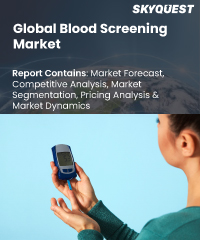
Blood Screening Market
Report ID: SQMIG35D2344
Report ID: SQMIG35D2344
sales@skyquestt.com
USA +1 351-333-4748
Report ID:
SQMIG35D2344 |
Region:
Global |
Published Date: August, 2025
Pages:
182
|Tables:
91
|Figures:
73





Global Blood Screening Market size was valued at USD 3.61 Billion in 2024 and is poised to grow from USD 4 Billion in 2025 to USD 9.16 Billion by 2033, growing at a CAGR of 10.9% during the forecast period (2026–2033).
Advancements in blood screening technologies, high demand for blood transfusions, launch of initiatives to promote awareness blood donation safety, high incidence of infectious diseases, and expansion of healthcare facilities are augmenting the adoption of blood screening on a global level.
The increasing global burden of infectious diseases like HIV, Hepatitis B and C, Zika virus, and syphilis is a key driver for the blood screening market growth. Aging populations, trauma cases, surgeries, and cancer treatments have significantly increased the global demand for blood transfusions, driving the need for effective blood screening. Government-led health initiatives and stringent regulatory frameworks for blood safety are significantly boosting the adoption of blood screening solutions. Continuous innovation in blood screening technologies is transforming diagnostic efficiency, accuracy, and speed. Advancements like nucleic acid amplification testing (NAT), chemiluminescent immunoassays, and next-generation sequencing (NGS) offer higher sensitivity and earlier detection of pathogens.
On the contrary, high costs of advanced screening technologies, lack of trained professionals, regulatory challenges, and limited testing in rural areas are estimated to limit the global blood screening market penetration through 2032 and beyond.
How are Automation and AI Changing the Blood Screening Process?
The adoption of AI and automation is transforming the blood screening landscape. AI-powered algorithms are improving test accuracy by minimizing human error and interpreting complex data patterns in infectious disease markers. Automated platforms streamline sample handling, result reporting, and workflow management, increasing lab efficiency and throughput. Integration with laboratory information systems (LIS) enhances data traceability and regulatory compliance. These technologies are especially valuable in high-volume settings like blood banks and hospitals. By enabling faster turnaround times and reducing operational costs, AI and automation are becoming indispensable tools for modernizing blood screening processes and meeting rising demands for accuracy and speed.
Market snapshot - 2026-2033
Global Market Size
USD 3.22 billion
Largest Segment
Reagents & Kits
Fastest Growth
Instruments
Growth Rate
10.9% CAGR
To get more insights on this market click here to Request a Free Sample Report
Global blood screening market is segmented by product, technology, end user and region. Based on product, the market is segmented into reagents & kits, instruments and software & services. Based on technology, the market is segmented into nucleic acid tests (NAT), serology/immunoassays, rapid tests, western blot assays and next-generation sequencing (NGS). Based on end user, the market is segmented into blood banks and hospitals. Based on region, the market is segmented into North America, Europe, Asia Pacific, Latin America, and Middle East & Africa.
Which Blood Screening Product is Used Extensively?
The reagents and kits segment are estimated to hold the highest global blood screening market share going forward. Recurring use of reagents and kits for blood screening tests in hospitals, blood banks, and diagnostic labs is helping this segment maintain its dominance. Growing demand for specificity and accuracy in blood analysis are also expected to help bolster the demand for reagents and kits in blood screening.
On the other hand, the demand for instruments is slated to rise at a robust pace over the coming years. Growing demand for effective diagnostic solutions and technological advancements are slated to help create new opportunities for blood screening instrument suppliers through 2032.
Which Blood Screening Technology is Preferred by Healthcare Professionals?
The nucleic acid tests (NAT) segment is slated to spearhead the global blood screening market revenue generation potential over the coming years. Rising incidence of infectious diseases and high sensitivity and specificity of this technology are helping this segment hold sway over others. Advancements in nucleic acid technologies and innovation are also slated to further cement the high share of this segment.
Meanwhile, the demand for next-generation sequencing (NGS) is slated to rise at a notable pace in the long run as per this blood screening market forecast. Significant reduction of genomic sequencing costs and high demand for personalized medicine are creating new business scope via this segment over the coming years.
To get detailed segments analysis, Request a Free Sample Report
Why is Adoption of Blood Screening High in North America?
Stringent regulatory standards and presence of a developed healthcare infrastructure are positioning this region as a leader in blood screening demand. Government funding, extensive insurance coverage, and the presence of leading diagnostic companies foster continuous innovation in blood screening technologies and techniques. Growing awareness regarding infectious diseases, emphasis on early detection, and surge in demand for safe blood transfusions are expected to further cement the dominance of this region in the future.
Blood Screening Market in United States
Stringent FDA regulations, widespread adoption of nucleic acid testing (NAT), and the high prevalence of transfusion-transmissible infections (TTIs) are helping United States dominate blood screening demand in North America. Rising number of surgeries and organ transplants coupled with the presence of top blood screening providers such as Abbott and Roche are also helping cement the high share of this country. Early adoption of advanced and novel blood screening technologies is also helping boost revenue generation.
Blood Screening Market in Canada
Centralized systems like Canadian Blood Services and Héma-Québec are responsible for enforcing standardized testing protocols and high safety standards for blood screening. Strong public health infrastructure, universal healthcare coverage, and rising demand for safe transfusions are ensuring steady blood screening demand in Canada. The country also promotes voluntary donation through public education thereby driving the demand for advanced blood screening solutions.
Why are Blood Screening Innovators Targeting Asia Pacific?
Growing healthcare expenditure, urbanization, and rising awareness of transfusion safety make Asia Pacific the fastest growing market for blood screening providers in the world. Surge in prevalence of trauma, surgeries, and chronic illnesses is also driving up the demand for blood transfusions that are safe and infection-free. Growing investment from private players and the push for quality healthcare standards are rapidly boosting blood screening solution demand in this region going forward.
Blood Screening Market in Japan
Presence of highly urbanized population and rapidly expanding senescent population are helping boost the adoption of blood screening solutions in Japan. The Japanese Red Cross Society has a major say in all blood donations and screenings, ensuring centralized, high-quality testing. Continued innovation, particularly in automation and molecular diagnostics is helping create new opportunities in the country. Japan maintains one of the most efficient and technologically advanced blood screening systems globally.
Blood Screening Market in South Korea
Growing healthcare accessibility and rising demand for blood transfusions are estimated to bolster the demand for blood screening in the country going forward. The Korean Red Cross manages most donations and implements advanced screening methods such as NAT and enzyme immunoassays. South Korea’s tech-savvy healthcare system encourages integration of AI and smart diagnostics, positioning it as a regional leader in modern blood screening infrastructure and innovation.
Should Blood Screening Companies Invest in Europe?
High public awareness regarding blood safety and stringent EU regulations for the same are slated to drive up the demand for blood screening in Europe. Growing adoption of advanced screening technologies, including NAT and ELISA-based diagnostics is also estimated to create new opportunities. Ongoing innovation, public funding, and a focus on early disease detection are slated to ensure sustained demand for blood screening solutions in the region across the study period and beyond.
Blood Screening Market in United Kingdom
National Health Service (NHS) and its specialized authority, NHS Blood and Transplant (NHSBT) are responsible for governing blood screening adoption in the country. Mandatory blood screening for indications such as HIV, HBV, HCV, HTLV, and syphilis is also creating new opportunities in the United Kingdom. Technological upgrades in lab automation and data systems are also estimated to improve blood screening efficiency in the long run.
Blood Screening Market in Germany
Presence of a well-established healthcare system and high adoption of advanced screening technologies, including NAT and ELISA in blood donation centers help boost revenue generation in Germany. High rates of voluntary blood donation, robust donor eligibility criteria, and public health initiatives also help the country boost the sales of blood screening solutions. Emphasis on early detection and laboratory automation is also creating new opportunities.
Blood Screening Market in France
The demand for blood screening in France is influenced by Établissement Français du Sang (EFS), which ensures high-quality screening and centralized management of blood donations. Widspread access to blood transfusions via public healthcare system, participation in EU-wide health initiatives, and growing chronic disease burden are slated to ensure sustained demand for blood screening in France across the study period.
To know more about the market opportunities by region and country, click here to
Buy The Complete Report
Blood Screening Market Drivers
Increasing Awareness Regarding Blood Donation Safety
Expansion of Healthcare Infrastructure in Developing Countries
Blood Screening Market Restraints
Regulatory Challenges and Long Approval Processes
Lack of Skilled Laboratory Professionals
Request Free Customization of this report to help us to meet your business objectives.
Blood screening providers should focus on raising more awareness regarding the importance of blood donations and transfusions to maximize their sales potential. Investing in the R&D of novel portable and rapid blood screening solutions is also a key opportunity for companies as per this global blood screening market analysis.
Use of advanced technologies and techniques to improve efficacy and efficiency of blood screening procedures is the prime focus of startups. Here are some startups that have the potential to augment the blood screening industry in the long run.
Top Player’s Company Profiles
Recent Developments in Blood Screening Market
SkyQuest’s ABIRAW (Advanced Business Intelligence, Research & Analysis Wing) is our Business Information Services team that Collects, Collates, Correlates, and Analyses the Data collected by means of Primary Exploratory Research backed by robust Secondary Desk research.
As per SkyQuest analysis, growing demand for blood transfusions and high incidence of infectious diseases are anticipated to drive the demand for blood screening going forward. However, the high costs of advanced blood screening and limited testing in rural areas are slated to slow down the adoption of blood screening in the future. North America is slated to spearhead the demand for blood screening owing to the presence of a developed healthcare infrastructure and adoption of advanced blood screening technologies. Development of molecular and point of care blood screening solutions are anticipated to be key trends driving the blood screening industry through 2032 and beyond.
| Report Metric | Details |
|---|---|
| Market size value in 2024 | USD 3.61 Billion |
| Market size value in 2033 | USD 9.16 Billion |
| Growth Rate | 10.9% |
| Base year | 2024 |
| Forecast period | 2026-2033 |
| Forecast Unit (Value) | USD Billion |
| Segments covered |
|
| Regions covered | North America (US, Canada), Europe (Germany, France, United Kingdom, Italy, Spain, Rest of Europe), Asia Pacific (China, India, Japan, Rest of Asia-Pacific), Latin America (Brazil, Rest of Latin America), Middle East & Africa (South Africa, GCC Countries, Rest of MEA) |
| Companies covered |
|
| Customization scope | Free report customization with purchase. Customization includes:-
|
To get a free trial access to our platform which is a one stop solution for all your data requirements for quicker decision making. This platform allows you to compare markets, competitors who are prominent in the market, and mega trends that are influencing the dynamics in the market. Also, get access to detailed SkyQuest exclusive matrix.
Table Of Content
Executive Summary
Market overview
Parent Market Analysis
Market overview
Market size
KEY MARKET INSIGHTS
COVID IMPACT
MARKET DYNAMICS & OUTLOOK
Market Size by Region
KEY COMPANY PROFILES
Methodology
For the Blood Screening Market, our research methodology involved a mixture of primary and secondary data sources. Key steps involved in the research process are listed below:
1. Information Procurement: This stage involved the procurement of Market data or related information via primary and secondary sources. The various secondary sources used included various company websites, annual reports, trade databases, and paid databases such as Hoover's, Bloomberg Business, Factiva, and Avention. Our team did 45 primary interactions Globally which included several stakeholders such as manufacturers, customers, key opinion leaders, etc. Overall, information procurement was one of the most extensive stages in our research process.
2. Information Analysis: This step involved triangulation of data through bottom-up and top-down approaches to estimate and validate the total size and future estimate of the Blood Screening Market.
3. Report Formulation: The final step entailed the placement of data points in appropriate Market spaces in an attempt to deduce viable conclusions.
4. Validation & Publishing: Validation is the most important step in the process. Validation & re-validation via an intricately designed process helped us finalize data points to be used for final calculations. The final Market estimates and forecasts were then aligned and sent to our panel of industry experts for validation of data. Once the validation was done the report was sent to our Quality Assurance team to ensure adherence to style guides, consistency & design.
Analyst Support
Customization Options
With the given market data, our dedicated team of analysts can offer you the following customization options are available for the Blood Screening Market:
Product Analysis: Product matrix, which offers a detailed comparison of the product portfolio of companies.
Regional Analysis: Further analysis of the Blood Screening Market for additional countries.
Competitive Analysis: Detailed analysis and profiling of additional Market players & comparative analysis of competitive products.
Go to Market Strategy: Find the high-growth channels to invest your marketing efforts and increase your customer base.
Innovation Mapping: Identify racial solutions and innovation, connected to deep ecosystems of innovators, start-ups, academics, and strategic partners.
Category Intelligence: Customized intelligence that is relevant to their supply Markets will enable them to make smarter sourcing decisions and improve their category management.
Public Company Transcript Analysis: To improve the investment performance by generating new alpha and making better-informed decisions.
Social Media Listening: To analyze the conversations and trends happening not just around your brand, but around your industry as a whole, and use those insights to make better Marketing decisions.
REQUEST FOR SAMPLE
 REQUEST FREE CUSTOMIZATION






























Want to customize this report? This report can be personalized according to your needs. Our analysts and industry experts will work directly with you to understand your requirements and provide you with customized data in a short amount of time. We offer $1000 worth of FREE customization at the time of purchase.
Feedback From Our Clients


 USA (+1) 351-333-4748