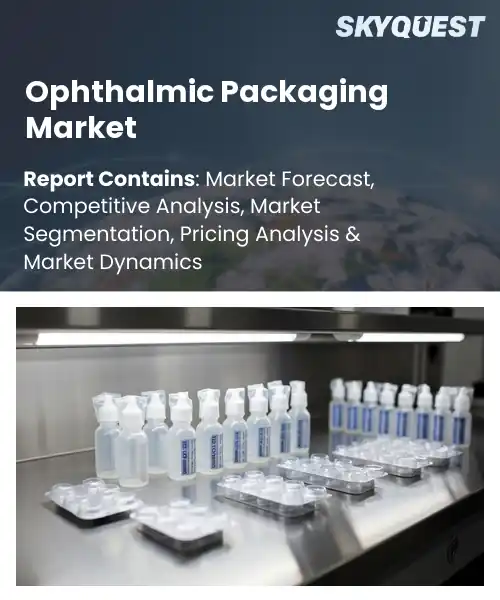
Ophthalmic Packaging Market
Report ID: SQMIG35B2304
Report ID: SQMIG35B2304
sales@skyquestt.com
USA +1 351-333-4748
Report ID:
SQMIG35B2304 |
Region:
Global |
Published Date: May, 2026
Pages:
157
|Tables:
145
|Figures:
73





Global Ophthalmic Packaging Market size was valued at USD 982.5 Million in 2024 and is poised to grow from USD 1049.51 Million in 2025 to USD 1785.4 Million by 2033, growing at a CAGR of 6.82% during the forecast period (2026-2033).
The ophthalmic packaging industry revolves around how primary and secondary containers are designed and built for eye-care products like eyedrops, ointments, intraocular lenses and surgical devices , and it matters because the packaging affects sterility, dosing accuracy, and whether patients actually stick with treatment. Over the years, this market moved from glass bottles and plain squeezable tubes to multidose systems without preservatives, unit-dose blister packs, and solutions that are tamper-evident and cold-chain compatible, mostly because regulators got stricter and patient-safety worries kept growing. Like, when preservative-free multidose dispensers became more common, contamination risk dropped for long-term dry-eye therapies, and at the same time, single-use vials turned into the norm for intravitreal injections in a lot of hospitals.
From there, higher safety expectations made technology in materials science feel like a standout growth driver. Biocompatible polymers, along with barrier coatings that are more sophisticated, help extend shelf life and support lighter, patient-friendly dispensers. That then lowers logistics overhead and also tends to improve compliance. For example, low-density polyethylene combined with multilayer barrier structures reduced oxygen entry for antibiotic eye-drop formats, which meant longer marketable shelf life and fewer recall events. On top of that, injectable device packaging that uses RFID tracking has helped cut inventory mistakes in ophthalmic surgery centers, so packaging companies can team up with suppliers and hospitals to deliver bundled services, and that’s where a chunk of new revenue can show up.
AI is basically pushing quality control higher in ophthalmic packaging by blending machine vision with anomaly detection and adaptive learning. The big factors include automated optical inspection for lenses, vials, and blisters, training that keeps adjusting when new defect types appear, and then linking the outputs to traceability systems for safety and regulatory reporting. Right now, many manufacturers are stepping away from manual sampling toward continuous inline inspection, mainly to reduce subjective errors and keep results steadier. The effect is that sterile product integrity gets protected, brand trust holds up, and line release can happen faster. In practice, AI is being used for syringe checks and blister validation, and pretrained classifiers that verify labels and seals.
Market snapshot - (2026-2033)
Global Market Size
USD 982.5 Million
Largest Segment
Bottles
Fastest Growth
Unit Dose Containers
Growth Rate
6.82% CAGR
To get more insights on this market click here to Request a Free Sample Report
The global ophthalmic packaging market is segmented by packaging type, material, application, end-user, distribution, and region. Based on packaging type, the market is segmented into Bottles, Tubes, Vials, and unit-dose containers. Based on material, the market is segmented into Plastic (HDPE, LDPE, PP) and Glass. Based on application, the market is segmented into Eye Drops, Eye Ointments, and Ophthalmic Solutions. Based on end-user, the market is segmented into Pharmaceutical Manufacturers, Hospitals, and Retail Pharmacies. Based on distribution, the market is segmented into Direct and Distributors. Based on region, the market is segmented into North America, Europe, Asia Pacific, Latin America, and the Middle East & Africa.
As per the ophthalmic packaging market analysis, the bottles segment dominated the market because bottles blend proven closure systems with adaptable dispensing designs, which help keep sterility intact while still allowing a controlled dose. Their compatibility with regular ophthalmic formulations matters too; it helps cut down leachables and also backs a longer shelf life, and that’s the thing manufacturers tend to like. Filling and sterilization steps are familiar to most producers, so overall complexity and cost stay lower. That naturally pushes broad use in eye drops and solution-type products, and it also adds that extra layer of regulatory comfort since bottle-based packaging is already established.
However, the unit dose containers are showing up as the faster-growing part of the market, mostly tied to patient-focused convenience and a single-use approach that reduces contamination exposure. Travel-friendly dosing is getting more attention, as well as at-home administration routines and, more importantly, the regulatory push toward preservative-free options. This combination is speeding up demand, and it’s also nudging companies to innovate in materials as well as delivery mechanisms, so it opens new chances across multiple treatment pathways.
According to the ophthalmic packaging market forecast, plastic (HDPE, LDPE, PP) is the dominant choice in ophthalmic packaging because it’s lightweight, fairly tough, and usually more cost-effective, plus it matches common eye care formulations well. Plastic shows up in both eye drop bottles and unit dose packaging since it gives convenience, flexibility, and tends to improve product safety. It’s also easier for large-scale production, and with the rising need for sterile ophthalmic products, the segment keeps staying on top across different pharmaceutical applications.
Glass, meanwhile, is expected to have the largest ophthalmic packaging market share across the forecast period. The main reason is the rising interest in premium packaging that’s chemically stable and reliable. Glass brings strong barrier performance and a higher level of resistance to contamination, so it’s a better fit for sensitive ophthalmic formulations. On top of that, the growing attention to sustainable packaging, along with broader use of specialized pharmaceutical products and preservative-free eye care, should support glass expansion globally.
To get detailed segments analysis, Request a Free Sample Report
As per the ophthalmic packaging market regional forecast, North America dominates the market, with a lot of factors aligning, advanced clinical infrastructure, a bunch of industry leadership that’s concentrated, and an innovation ecosystem that’s already really strong. The region has this solid footprint of major ophthalmic device and pharmaceutical companies, so demand keeps rising for specialized packaging solutions. It also pushes teamwork with material science and engineering partners. On top of that, regulatory expectations are strict, and there are established quality systems, so companies are more willing to adopt sterile, tamper-evident, and patient-friendly formats. There is also a mature distribution network and contract manufacturing that’s experienced, which helps in scaling production and getting to market faster.
United States Ophthalmic Packaging Market
The United States Ophthalmic Packaging industry puts a big weight on technical proficiency, extensive contract manufacturing, and strict regulatory compliance. Companies tend to center on sterile single-use systems, patient-focused dosing designs, and sustainable material choices, while also coordinating with clinical research and device developers. Strong distribution, plus quality management systems, helps keep supply dependable for hospitals and specialty clinics. This supports the introduction of new packaging innovations and keeps collaboration going between manufacturers, assemblers, and healthcare providers across the value chain, without much gap.
Canada Ophthalmic Packaging Market
The Ophthalmic Packaging Market outlook in Canada is shaped by specialized contract development and manufacturing know-how, regulatory alignment, and close collaboration with clinical and academic groups. Suppliers often highlight adaptable production runs, sterilization competence, and eco-conscious materials, mainly to match shifting clinician expectations and patient preferences. Regional healthcare networks and technology incubators also help with pilot manufacturing and process innovation. That makes it easier for firms to handle domestic demand and also pursue cross-border opportunities through coordinated supply chain work and consistent quality assurance practices.
The European ophthalmic packaging market penetration is driven by a mix of concentrated pharmaceutical and medical technology clusters, plus a regulatory focus that’s moving more toward safety and sustainability. There’s also a strong supplier culture around technical innovation. Regional manufacturers are now investing in specialized formats for sterile delivery, child-resistant and tamper-evident characteristics, and eco-conscious materials, basically responding to pressure from stakeholders . Cross-border cooperation among manufacturers, contract packagers, and clinical networks helps scale up faster, and makes knowledge sharing smoother. Demand for patient-friendly dosing setups , and packaging that’s tailored for advanced ophthalmic therapies, encourages strategic partnerships and more localized production. All of that reinforces Europe position as a quality-driven market that stays dynamic. Investment in automation and traceability is improving manufacturing efficiency, and it strengthens supply chain resilience too. Meanwhile, startups and research institutions create momentum for child-safe designs and newer delivery mechanisms, so the region role in innovative packaging gets stronger, in a practical way.
Germany Ophthalmic Packaging Market
In Germany, the Ophthalmic Packaging sector benefits from deep engineering knowledge, strong manufacturing infrastructure, and tight integration between medical device manufacturers and packaging specialists. The emphasis on regulatory compliance and precision manufacturing supports advanced sterile formats and careful material selection. German firms rely on automation and process control, so output stays consistent, and innovation keeps moving. They also use research partnerships to support leadership in technical packaging solutions that fit complex ophthalmic therapies and the way clinical practice actually runs.
United Kingdom Ophthalmic Packaging Market
The United Kingdom Ophthalmic Packaging Market has a lively innovation ecosystem and a startup community that focuses on quick development cycles. Firms tend to push flexible manufacturing, improved dosing mechanisms, and advanced labeling, including serialization, to meet changing clinical needs. Collaboration with academic centers and service providers speeds up pilot programs and helps with scale-up later. A supportive policy environment, along with responsive supply chains, allows swift adoption of next-gen packaging solutions across both clinical and retail channels.
France Ophthalmic Packaging Market
In the French Ophthalmic Packaging market , things are starting to take more shape a bit, with a real emphasis on sustainable materials, the overall look and feel, and those close,almost hand in hand partnerships between CDMOs and clinical research centers. A lot of French manufacturers seem to lean toward tailor-made small batch production , plus deep know how in sterilization. They are also pushing innovative primary packaging, trying to balance how easy it is for patients to use with the environmental realities out there, not just the theory. Collaboration with design firms and hospital networks helps validate user-centered formats, while regional incubators and technical specialists support scale-up and the integration of advanced materials across broader European supply chains, without losing coordination.
Asia Pacific is strengthening its standing in the ophthalmic packaging market by leaning on manufacturing scale , some targeted technological push, and a tighter fit with international quality rules. In practice, regional producers are upgrading what they can do in precision molding, sterilization, and automated packaging lines , while also switching to specialized materials for delicate ophthalmic formulations. There is also more back-and-forth between local manufacturers and global suppliers, which helps with know-how transfer and makes it faster to adopt patient centric designs and serialization technologies. At the same time, market players are answering the higher demand with more localized product development, flexible production setups, and added investments in training , and quality systems, so the region can move from mainly cost driven output toward higher value, innovation led packaging solutions. Governments and industry consortia are promoting R&D and regulatory alignment, while manufacturers are trying to weave in microfluidic elements and smart label technologies, improving both function and traceability. Taken together, and with growing domestic clinical research, Asia Pacific’s role in global ophthalmic packaging innovation and supply reliability is getting stronger.
The Ophthalmic Packaging Market growth in Japan is powered by precision engineering, deep materials science competence, and strict quality standards. Japanese manufacturers tend to focus on high-precision molding, sterilization technologies, and the incorporation of advanced labeling and tracking mechanisms. Collaboration between research institutes and industry helps bring about compact, easy-to-handle delivery systems meant for more sophisticated ophthalmic therapies. A mindset of continuous improvement and automation supports dependable production, yet it stays anchored on patient safety and regulatory compliance.
The Ophthalmic Packaging Market in South Korea looks more defined by modernization of manufacturing facilities, strong electronics integration, and an explicit interest in innovation. Korean companies stress flexible automated production, accurate molding, and the inclusion of smart labeling and tracking, so traceability gets better. Cooperation with biotech companies and research centers supports packaging that is tuned to advanced ophthalmic therapeutics. With emphasis on quality management and export readiness, South Korea is positioning itself as a key regional supplier.
To know more about the market opportunities by region and country, click here to
Buy The Complete Report
Rising Demand For Ophthalmic Devices
Advances In Sustainable Packaging
Stringent Regulatory Compliance Requirements
High Costs Of Advanced Material Adoption
Request Free Customization of this report to help us to meet your business objectives.
Competition in the global ophthalmic packaging market is being pushed by the quick uptake of preservative-free multidose systems and patient-first dispenser concepts, which then nudges players toward M&A, licensing, and co-development, just to lock in those core platform technologies. Recent activity like Gerresheimer folding in with Bormioli for ophthalmic containment, Aptar moving through strategic commercial partnerships so they can roll out more advanced multidose droppers, and Berry Global working with Pylote on antimicrobial dispenser materials, so their catalog can feel more differentiated.
Top Player’s Company Profile
Recent Developments in the Ophthalmic Packaging Market
SkyQuest’s ABIRAW (Advanced Business Intelligence, Research & Analysis Wing) is our Business Information Services team that Collects, Collates, Correlates, and Analyses the Data collected by means of Primary Exploratory Research backed by robust Secondary Desk research.
As per SkyQuest analysis, overall, the global ophthalmic packaging market is being driven by growing demand for ophthalmic devices, and sustainable packaging progress is acting like a second driver, backing up innovation and shifting procurement toward recyclable and low-waste formats. The flip side is that growth is restrained by strict regulatory compliance, which tends to stretch development time and raise costs for sterile formats. North America still dominates, mostly because it has advanced clinical infrastructure, a strong industry base, and regulatory rigor, and bottles are still the dominating segment because established closure systems and dosing reliability make them a go-to choice for a lot of eye care products. In the end, the market is balancing patient safety, material innovation, and cost pressure, while suppliers pursue packaging solutions that are both differentiated and compliant.
| Report Metric | Details |
|---|---|
| Market size value in 2024 | USD 982.5 Million |
| Market size value in 2033 | USD 1785.4 Million |
| Growth Rate | 6.82% |
| Base year | 2024 |
| Forecast period | (2026-2033) |
| Forecast Unit (Value) | USD Million |
| Segments covered |
|
| Regions covered | North America (US, Canada), Europe (Germany, France, United Kingdom, Italy, Spain, Rest of Europe), Asia Pacific (China, India, Japan, Rest of Asia-Pacific), Latin America (Brazil, Rest of Latin America), Middle East & Africa (South Africa, GCC Countries, Rest of MEA) |
| Companies covered |
|
| Customization scope | Free report customization with purchase. Customization includes:-
|
To get a free trial access to our platform which is a one stop solution for all your data requirements for quicker decision making. This platform allows you to compare markets, competitors who are prominent in the market, and mega trends that are influencing the dynamics in the market. Also, get access to detailed SkyQuest exclusive matrix.
Table Of Content
Executive Summary
Market overview
Parent Market Analysis
Market overview
Market size
KEY MARKET INSIGHTS
COVID IMPACT
MARKET DYNAMICS & OUTLOOK
Market Size by Region
KEY COMPANY PROFILES
Methodology
For the Ophthalmic Packaging Market, our research methodology involved a mixture of primary and secondary data sources. Key steps involved in the research process are listed below:
1. Information Procurement: This stage involved the procurement of Market data or related information via primary and secondary sources. The various secondary sources used included various company websites, annual reports, trade databases, and paid databases such as Hoover's, Bloomberg Business, Factiva, and Avention. Our team did 45 primary interactions Globally which included several stakeholders such as manufacturers, customers, key opinion leaders, etc. Overall, information procurement was one of the most extensive stages in our research process.
2. Information Analysis: This step involved triangulation of data through bottom-up and top-down approaches to estimate and validate the total size and future estimate of the Ophthalmic Packaging Market.
3. Report Formulation: The final step entailed the placement of data points in appropriate Market spaces in an attempt to deduce viable conclusions.
4. Validation & Publishing: Validation is the most important step in the process. Validation & re-validation via an intricately designed process helped us finalize data points to be used for final calculations. The final Market estimates and forecasts were then aligned and sent to our panel of industry experts for validation of data. Once the validation was done the report was sent to our Quality Assurance team to ensure adherence to style guides, consistency & design.
Analyst Support
Customization Options
With the given market data, our dedicated team of analysts can offer you the following customization options are available for the Ophthalmic Packaging Market:
Product Analysis: Product matrix, which offers a detailed comparison of the product portfolio of companies.
Regional Analysis: Further analysis of the Ophthalmic Packaging Market for additional countries.
Competitive Analysis: Detailed analysis and profiling of additional Market players & comparative analysis of competitive products.
Go to Market Strategy: Find the high-growth channels to invest your marketing efforts and increase your customer base.
Innovation Mapping: Identify racial solutions and innovation, connected to deep ecosystems of innovators, start-ups, academics, and strategic partners.
Category Intelligence: Customized intelligence that is relevant to their supply Markets will enable them to make smarter sourcing decisions and improve their category management.
Public Company Transcript Analysis: To improve the investment performance by generating new alpha and making better-informed decisions.
Social Media Listening: To analyze the conversations and trends happening not just around your brand, but around your industry as a whole, and use those insights to make better Marketing decisions.
REQUEST FOR SAMPLE
 REQUEST FREE CUSTOMIZATION
Global Ophthalmic Packaging Market size was valued at USD 982.5 Million in 2024 and is poised to grow from USD 1049.51 Million in 2025 to USD 1785.4 Million by 2033, growing at a CAGR of 6.82% during the forecast period (2026-2033).
Competition in the global ophthalmic packaging market is driven by rapid adoption of preservative-free multidose systems and patient-centric dispensers, forcing companies into M&A, licensing and co-development to secure platform technologies. Recent moves include Gerresheimer’s integration with Bormioli for ophthalmic containment, Aptar’s strategic commercial partnerships to deploy advanced multidose droppers, and Berry Global’s collaboration with Pylote on antimicrobial dispenser materials to differentiate offerings. 'Gerresheimer AG', 'Aptar Group', 'Berry Global Group', 'AptarGroup', 'West Pharmaceutical Services', 'Silgan Holdings', 'Nemera SA', 'Bormioli Pharma', 'Origin Pharma Packaging', 'Schott AG', 'SGD Pharma', 'Ampac Holdings', 'DS Smith (packaging)', 'Tekni-Plex', 'Shreeji Pharma International'
The growing prevalence of eye disorders and the resulting increased use of surgical and therapeutic ophthalmic products have expanded demand for specialized packaging that preserves sterility and functionality. Manufacturers respond by investing in tailored blister packs, vials, and droppers that meet regulatory and clinical needs, fostering development of new materials and formats. This demand encourages suppliers to scale production, refine quality control, and collaborate with device makers to create packaging solutions that reduce contamination risk and improve product usability, thereby supporting market expansion.
Sustainable Materials Shift: The ophthalmic packaging sector is increasingly prioritizing sustainable materials and circular design to meet customer expectations and reduce environmental footprint. Manufacturers and brand owners are exploring biodegradable films, recyclable laminates, and mono-material constructions that simplify sorting and recovery. Suppliers are collaborating across value chains to redesign seals and secondary packaging for reuse and reduced waste. This transition emphasizes supply chain transparency, traceability, and supplier partnerships while balancing performance, sterility assurance, and patient safety considerations in product development and commercialization processes.
Why does North America Dominate the Global Ophthalmic Packaging Market? |@12










































Want to customize this report? This report can be personalized according to your needs. Our analysts and industry experts will work directly with you to understand your requirements and provide you with customized data in a short amount of time. We offer $1000 worth of FREE customization at the time of purchase.
Feedback From Our Clients


 USA (+1) 351-333-4748