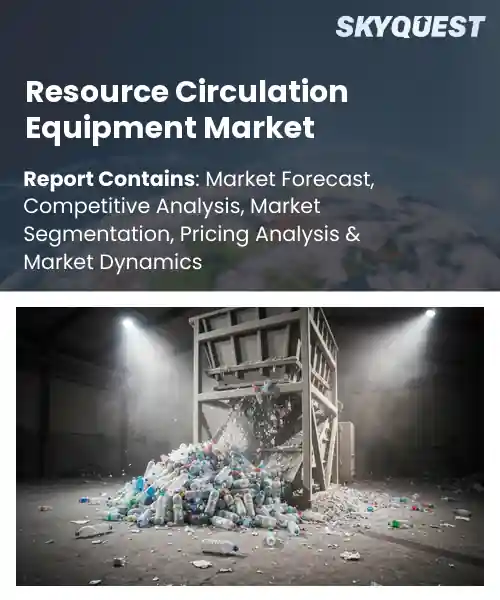
Resource Circulation Equipment Market
Report ID: SQMIG20I3102
Report ID: SQMIG20I3102
sales@skyquestt.com
USA +1 351-333-4748
Report ID:
SQMIG20I3102 |
Region:
Global |
Published Date: June, 2026
Pages:
157
|Tables:
162
|Figures:
78





Global Resource Circulation Equipment Market size was valued at USD 26.3 Billion in 2024 and is poised to grow from USD 27.56 Billion in 2025 to USD 40.04 Billion by 2033, growing at a CAGR of 4.78% during the forecast period (2026-2033).
The main push behind the resource circulation equipment market growth is rising policy and business pressure to break the link between economic activity and virgin material use. Basically, the market includes machines and systems that sort, process and reshape waste streams into reclaimable feedstocks so producers can run circular supply routes. What makes it matter is that it brings measurable drops in carbon intensity and material expenses, and at the same time strengthens supply stability.
Building on regulatory momentum, technological improvement is the real engine for expanding the resource circulation equipment industry, because more capable units raise recovery performance and also create extra income paths. When firms roll out AI-guided optical sorters plus sensor-loaded conveyors, they cut contamination and improve recyclate purity, so manufacturers can replace virgin inputs with recycled content and then charge more for the material they receive. Modular anaerobic digesters used by food operators turn organic waste into biogas, which eases energy costs while yielding digestate for soil enhancement. Those effects pull in investment, help scale economics, and also widen opportunities in e-waste recovery and construction material reclaiming, since the recovered material’s value starts to justify the capex.
AI improves efficiency in this resource circulation equipment sector by pairing smarter material identification with predictive operations plus remote monitoring and insights. A few key elements are computer vision for sorting mixed streams, adaptive sorting that responds to changing feed, and AI driven maintenance that limits unexpected downtime. The sector has moved from standalone machines to connected setups that take data, learn patterns, and refine performance over time. In practice you’ll see optical sorters adapting to new polymer varieties and robotic systems picking through complicated waste combinations. These upgrades make facilities tougher against disruption, reduce the amount of manual redo work, and shorten the trial period when plants switch to new recycling targets.
Market snapshot - (2026-2033)
Global Market Size
USD 26.3 Billion
Largest Segment
Sorting Equipment
Fastest Growth
Sorting Equipment
Growth Rate
4.78% CAGR
To get more insights on this market click here to Request a Free Sample Report
The global resource circulation equipment market is segmented by equipment type, technology, waste type, application, end use industry and region. Based on equipment type, the market is segmented into Sorting Equipment, Crushing & Shredding Equipment, Screening Equipment, Separation Equipment, Compacting & Baling Equipment, Washing & Cleaning Equipment, Material Recovery Facilities (MRF) Systems and Others. Based on technology, the market is segmented into Mechanical Recycling, Chemical Recycling, Biological Recycling, Thermal Treatment and Hybrid Systems. Based on waste type, the market is segmented into Municipal Solid Waste (MSW), Industrial Waste, Construction & Demolition Waste, Electronic Waste (E-Waste), Plastic Waste, Metal Waste, Organic Waste and Others. Based on application, the market is segmented into Waste Collection & Processing, Resource Recovery & Recycling, Waste-to-Energy Conversion, Material Reuse & Remanufacturing and Others. Based on end use industry, the market is segmented into Waste Management Companies, Municipal Authorities, Manufacturing, Construction & Infrastructure, Mining & Metals, Energy & Utilities and Others. Based on region, the market is segmented into North America, Europe, Asia Pacific, Latin America and Middle East & Africa.
As per the resource circulation equipment market analysis, the Material Recovery Facilities (MRF) Systems segment sits on top, mostly because MRFs function like centralized hubs that bring together lots of different machines and deal with messy mixed waste flows. In practice this means coordinated sorting, bunching or consolidation, and then getting material ready for whatever downstream recycling streams are next. Their lead is not random, it’s more about scale savings, the regulatory recycling agenda being fairly in sync, solid working relationships with collectors and processors, and then the quick add-on of automation, robotics, and data analytics. Those improvements tend to boost material quality and also make operations run more smoothly, so investors keep paying attention and funding stays steady.
However, Sorting Equipment is the one growing fastest. Lately, advances in optical sensors, artificial intelligence, and also high throughput conveyor systems are pushing both purity and processing speed higher. There’s also more demand for modular upgrades, retrofit options for older facilities, and broader use across commercial as well as industrial waste. Because of that, manufacturers are trying new designs, plus they are building new service models and equipment packages, and that whole cycle helps the market expand faster, and recovery rates rise too.
According to the resource circulation equipment market forecast, the Mechanical Recycling segment dominates because the mechanical approach is already fairly mature, it fits well with the collection and processing infrastructure that many places already have, and it tends to produce outputs that are predictable for a lot of standard recycling streams. This dominance comes from lower operational complexity, familiar and routine material handling procedures, and direct connections to existing end markets for recovered materials. Because of those factors, waste managers and manufacturers often lean toward mechanical solutions for quick(er) circularity wins and for incremental equipment investment, instead of switching everything right away.
On the other hand, Chemical Recycling is showing up as the fastest moving technology. Innovations in depolymerization plus solvent-driven processes are widening feedstock flexibility and also improving the quality of the recyclate. More private investment is flowing in, corporations keep talking about circularity targets, and policy signals are supportive enough to help chemical plant scale up. All of that is increasing equipment demand and it also opens opportunities to pull value out of difficult, complex or contaminated plastics, while creating additional routes for recovering higher value materials.
To get detailed segments analysis, Request a Free Sample Report
As per the resource circulation equipment market regional forecast, Asia Pacific dominance comes together from concentrated manufacturing know how, strong industrial ecosystems and proactive circular economy behavior , where material recovery and reuse get the spotlight. There are established equipment makers and specialized suppliers that hand over a wide list of advanced sorting , treatment, and recovery solutions, all backed by deep engineering know-how and fairly localized supply chains. Policy nudges plus corporate commitments basically make deployment easier, and even retrofitting of high reliability systems more common, while collaboration between industry , research institutions, and logistics networks helps technology get tweaked faster and then rolled out in the market.
Japan Resource Circulation Equipment Market
The Resource Circulation Equipment Market in Japan blends advanced manufacturing strength with a mature industrial ecosystem and a strong preference for precision engineering. Well-known equipment producers pair with research institutes to polish sorting, treatment, and material recovery capabilities. Policy direction on efficient resource use plus corporate interest in circular practices drives demand, especially for customized , reliable systems. Aftermarket services and a skilled workforce also keep things running, supporting sustained deployment and smoother operational performance across both industrial and municipal settings.
South Korea Resource Circulation Equipment Market
The Resource Circulation Equipment Market in South Korea leans on electronics manufacturing ability, strong industrial linkage, and policy measures to move equipment adoption forward. Supplier teams, universities, and industrial groups collaborate to push development of smart sorting, automated material handling, and recovery systems that are more efficient. There’s a clear emphasis on technology integration , modular layouts and service networks that stay strong enough to support customization for different waste streams. Skilled technicians and manufacturing backup allow durable deployment and continuous upgrades in municipal as well as industrial applications.
Europe's resource circulation equipment market penetration is powered by cohesive policy frameworks, tougher environmental goals and a solid industrial backbone that basically needs sophisticated recovery and recycling gear. A well developed environmental services market, plus established waste management operators, keeps steady demand alive for high performance sorting, treatment, and material reprocessing technologies. Innovation clusters and cross border collaboration among manufacturers, research hubs, and municipalities help products get refined and shipped out faster. Investment in infrastructure modernization and circular business models encourages retrofitting and adoption of modular , interoperable equipment. Standards and certification, plus long term service ecosystems, also squeeze down adoption barriers, while access to skilled engineering talent and dependable industrial supply chains keeps manufacturing quality high and makes aftermarket support work smoothly across the region. Financing options, public private partnerships, and a growing corporate push toward material circularity are also major accelerators for commercial pickup and cross market exports of specialized equipment.
Germany Resource Circulation Equipment Market
The Resource Circulation Equipment Market in Germany rides on engineering heritage, precision production and a dense net of industrial partners plus environmental service providers. Municipal and industrial demand looks for sturdy sorting and recovery approaches. Manufacturers and research institutions collaborate to boost efficiency and maintain strict alignment with standards. Established service networks , and a focus on retrofitability, support consistent equipment performance and help reinforce German leadership across the regional market as well as export oriented momentum worldwide.
United Kingdom Resource Circulation Equipment Market
The Resource Circulation Equipment Market in the United Kingdom shows up through policy support, private sector innovation and a real interest in circular business concepts. A network of technology firms, service providers, and municipal operators runs pilots for integrated systems , blending smart sorting with digital monitoring and modular equipment. Public private collaboration and retrofit programs help commercialization through service based offerings. Skilled engineering talent and flexible suppliers help scale tailored equipment for urban and industrial users across a range of real operational scenarios.
France Resource Circulation Equipment Market
The Resource Circulation Equipment Market in France is gaining meaningful traction due to circular economy initiatives, supportive funding, and active collaboration among industry, research centers, and authorities. A lively startup atmosphere , along with industrial clusters, encourages innovation in sorting, recovery technologies, and modular equipment that fits multiple waste streams. Pilot deployments and retrofit programs, paired with robust aftersales services, encourage faster uptake. Skilled engineering talent and integrated supply chains strengthen commercialization routes and help operational scalability hold up across different sectors.
North America seems to be strengthening its role a bit through this mix of technological inventiveness, private investment, and cooperative operational patterns where equipment providers team up with waste and resource management companies. A lot of the big manufacturers lean into modular, interoperable systems and digital controls that make predictive maintenance more practical, and they push optimized throughput too. Then there are these wide service networks that allow quick deployment plus lifecycle support, so things don’t stall halfway. Sustainability commitments from corporations, and local policy incentives, nudge adoption across both industrial and municipal environments. At the same time, active startup ecosystems, plus close relationships between research institutions and industry, help products mature faster , not slowly, and cross border trade plus supply chain integration helps scale up. That also supports export orientation for specialized equipment solutions. Financing tools like public private partnerships , together with demand for resilient waste infrastructures, pull investment into new sites as well as major retrofit programs. And, a capable workforce, a strong focus on standards and interoperability, and growing commercial channels all help translate the innovation into broader market penetration across complicated supply chains.
United States Resource Circulation Equipment Market
The Resource Circulation Equipment Market in the United States is driven by a mix of diverse industries, engineering know how, and private investment toward innovative sorting, recovery, and materials processing hardware. Environmental services companies and sustainability initiatives tend to create demand for modular, digitally enabled systems, including retrofit solutions. Service networks, financing options, and research collaborations back product development , and deployment too. The emphasis on standards and lifecycle support also makes it easier for customers to adopt these solutions across municipal and industrial sectors, with an eye toward export orientation.
Canada Resource Circulation Equipment Market
The Resource Circulation Equipment Market penetration in Canada is influenced by provincial initiatives, industry collaboration, and a clear preference for resilient waste infrastructure that fits varied geographies. Equipment providers focus on modular, energy efficient systems , as well as retrofits that can handle dispersed feedstocks. Partnerships among manufacturers, utilities, and research institutions push localized innovation, and they also support sturdy aftersales services. Skilled technicians and integrated supply chains help ensure dependable deployment , and they make adaptation of specialized solutions more straightforward across municipal and industrial settings , effectively.
To know more about the market opportunities by region and country, click here to
Buy The Complete Report
Regulatory Support and Incentives
Technological Advancements In Sorting
High Capital Expenditure Requirements
Feedstock Variability and Contamination
Request Free Customization of this report to help us to meet your business objectives.
Competitive dynamics in the global resource circulation equipment market orbit around vertical integration targeted alliances and also strategic financing, which quietly shifts the edge toward companies that can deliver end to end services and more advanced sortation. Like for instance SOLARCYCLE is moving from recycling toward domestic glass manufacturing, while Coperion and Herbold Meckesheim created a dedicated recycling business unit so they can deliver turnkey plant solutions. At the same time investors have financed collection and reverse‑vending startups such as Olyns, basically to scale AI enabled collection.
Top Player’s Company Profile
Recent Developments in the Resource Circulation Equipment Market
SkyQuest’s ABIRAW (Advanced Business Intelligence, Research & Analysis Wing) is our Business Information Services team that Collects, Collates, Correlates, and Analyses the Data collected by means of Primary Exploratory Research backed by robust Secondary Desk research.
As per SkyQuest analysis, the global resource circulation equipment market is getting pushed forward by tougher policy and commercial pressure to cut down reliance on virgin materials. At the same time, fast technological progress, like AI enabled optical sorters, sensor fusion, and modular systems, is acting as a second driver. Together they raise recovery efficiency and scalability. Still, there’s a noticeable restraint, including the high upfront capital expenditure needed for procurement, installation, and integration, which tends to slow adoption for smaller operators. Asia Pacific is emerging as the leading region, mainly because of strong manufacturing ecosystems, and circular economy policies that are more proactive. And within that, Material Recovery Facilities (MRF) systems are the dominating segment, because they combine multiple equipment and deliver economies of scale. That mix keeps investment flowing.
| Report Metric | Details |
|---|---|
| Market size value in 2024 | USD 26.3 Billion |
| Market size value in 2033 | USD 40.04 Billion |
| Growth Rate | 4.78% |
| Base year | 2024 |
| Forecast period | (2026-2033) |
| Forecast Unit (Value) | USD Billion |
| Segments covered |
|
| Regions covered | North America (US, Canada), Europe (Germany, France, United Kingdom, Italy, Spain, Rest of Europe), Asia Pacific (China, India, Japan, Rest of Asia-Pacific), Latin America (Brazil, Rest of Latin America), Middle East & Africa (South Africa, GCC Countries, Rest of MEA) |
| Companies covered |
|
| Customization scope | Free report customization with purchase. Customization includes:-
|
To get a free trial access to our platform which is a one stop solution for all your data requirements for quicker decision making. This platform allows you to compare markets, competitors who are prominent in the market, and mega trends that are influencing the dynamics in the market. Also, get access to detailed SkyQuest exclusive matrix.
Table Of Content
Executive Summary
Market overview
Parent Market Analysis
Market overview
Market size
KEY MARKET INSIGHTS
COVID IMPACT
MARKET DYNAMICS & OUTLOOK
Market Size by Region
KEY COMPANY PROFILES
Methodology
For the Resource Circulation Equipment Market, our research methodology involved a mixture of primary and secondary data sources. Key steps involved in the research process are listed below:
1. Information Procurement: This stage involved the procurement of Market data or related information via primary and secondary sources. The various secondary sources used included various company websites, annual reports, trade databases, and paid databases such as Hoover's, Bloomberg Business, Factiva, and Avention. Our team did 45 primary interactions Globally which included several stakeholders such as manufacturers, customers, key opinion leaders, etc. Overall, information procurement was one of the most extensive stages in our research process.
2. Information Analysis: This step involved triangulation of data through bottom-up and top-down approaches to estimate and validate the total size and future estimate of the Resource Circulation Equipment Market.
3. Report Formulation: The final step entailed the placement of data points in appropriate Market spaces in an attempt to deduce viable conclusions.
4. Validation & Publishing: Validation is the most important step in the process. Validation & re-validation via an intricately designed process helped us finalize data points to be used for final calculations. The final Market estimates and forecasts were then aligned and sent to our panel of industry experts for validation of data. Once the validation was done the report was sent to our Quality Assurance team to ensure adherence to style guides, consistency & design.
Analyst Support
Customization Options
With the given market data, our dedicated team of analysts can offer you the following customization options are available for the Resource Circulation Equipment Market:
Product Analysis: Product matrix, which offers a detailed comparison of the product portfolio of companies.
Regional Analysis: Further analysis of the Resource Circulation Equipment Market for additional countries.
Competitive Analysis: Detailed analysis and profiling of additional Market players & comparative analysis of competitive products.
Go to Market Strategy: Find the high-growth channels to invest your marketing efforts and increase your customer base.
Innovation Mapping: Identify racial solutions and innovation, connected to deep ecosystems of innovators, start-ups, academics, and strategic partners.
Category Intelligence: Customized intelligence that is relevant to their supply Markets will enable them to make smarter sourcing decisions and improve their category management.
Public Company Transcript Analysis: To improve the investment performance by generating new alpha and making better-informed decisions.
Social Media Listening: To analyze the conversations and trends happening not just around your brand, but around your industry as a whole, and use those insights to make better Marketing decisions.
REQUEST FOR SAMPLE
 REQUEST FREE CUSTOMIZATION
Global Resource Circulation Equipment Market size was valued at USD 26.3 Billion in 2024 and is poised to grow from USD 27.56 Billion in 2025 to USD 40.04 Billion by 2033, growing at a CAGR of 4.78% during the forecast period (2026-2033).
Competitive dynamics in the global resource circulation equipment market center on vertical integration, targeted partnerships, and strategic financing that shift advantage toward firms offering end‑to‑end services and advanced sortation. For example, SOLARCYCLE is moving from recycling into domestic glass manufacturing, Coperion and Herbold Meckesheim created a dedicated recycling business unit to deliver turnkey plant solutions, and investors have financed collection and reverse‑vending startups such as Olyns to scale AI‑enabled collection. 'Veolia Environnement S.A.', 'SUEZ SA', 'Waste Management, Inc.', 'Republic Services, Inc.', 'Clean Harbors, Inc.', 'Hitachi Zosen Corporation', 'JFE Engineering Corporation', 'Kubota Corporation', 'Ebara Corporation', 'Doosan Enerbility', 'ANDRITZ AG', 'Metso Corporation', 'Terex Corporation', 'Komatsu Ltd.', 'Caterpillar Inc.', 'Liebherr Group', 'Hitachi Construction Machinery Co., Ltd.', 'Sumitomo Heavy Industries, Ltd.', 'Mitsubishi Heavy Industries, Ltd.', 'Shanghai Electric Group Company Limited'
Regulatory frameworks, incentives, and procurement policies reduce investment risk and encourage adoption of resource circulation equipment by creating predictable demand and cost offsets for organizations. Policy signals prompt manufacturers and service providers to prioritize circular technologies, accelerating product development and deployment cycles. Incentives and compliance mechanisms lower barriers to initial procurement and support pilot projects, enabling demonstration of operational benefits. Public procurement and mandates also stimulate private sector uptake by creating larger markets, which in turn attracts further investment and innovation focused on scaling equipment solutions for material recovery.
Digital Integration And Optimization: Adoption of advanced digital tools and connected sensors is accelerating operational visibility and control across recycling and resource processing equipment, enabling predictive maintenance, real time process adjustments and seamless coordination with downstream partners. Software driven optimization supports higher throughput consistency, reduced downtime and better asset utilization while creating interoperable data streams that facilitate performance benchmarking and circular business models. Operators are increasingly investing in modular, upgradeable platforms that integrate analytics and automation to unlock efficiency gains and scalable service offerings.
Why does Asia Pacific Dominate the Global Resource Circulation Equipment Market? |@12










































Want to customize this report? This report can be personalized according to your needs. Our analysts and industry experts will work directly with you to understand your requirements and provide you with customized data in a short amount of time. We offer $1000 worth of FREE customization at the time of purchase.
Feedback From Our Clients


 USA (+1) 351-333-4748