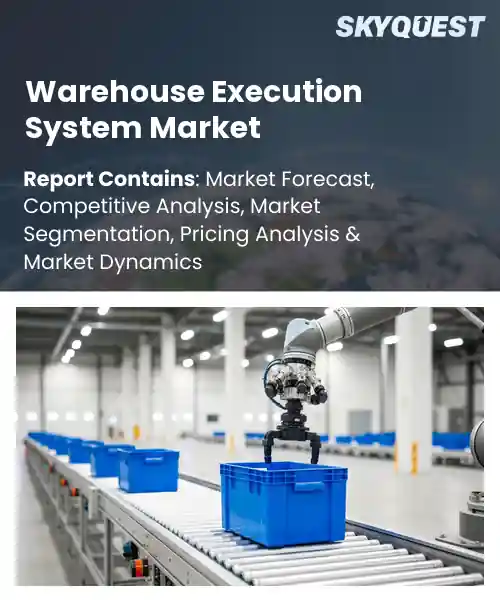
Warehouse Execution System Market
Report ID: SQMIG45F2325
Report ID: SQMIG45F2325
sales@skyquestt.com
USA +1 351-333-4748
Report ID:
SQMIG45F2325 |
Region:
Global |
Published Date: June, 2026
Pages:
157
|Tables:
150
|Figures:
78





Global Warehouse Execution System Market size was valued at USD 1.3 Billion in 2024 and is poised to grow from USD 1.5 Billion in 2025 to USD 4.64 Billion by 2033, growing at a CAGR of 15.19% during the forecast period (2026-2033).
The primary driver for the warehouse execution system market growth is ramping up demand for rapid and accurate order fulfillment, which is pushed by e commerce growth and the shifting things consumers now expect. A warehouse execution system coordinates people, software, and automation to choreograph tasks like picking, sorting and resource allocation in real time.
Moreover, one of the major factors for the growth is seamless integration of WES with automation, WMS, and analytics, because when these systems connect, dynamic task assignment and predictive resource balancing become possible, and that directly boosts throughput while also lowering operating costs. Retailers and third party logistics firms often hit seasonal spikes, plus chronic labor shortages, so they deploy WES to coordinate robots, conveyors, and human pickers. Then outbound accuracy tends to go up, while cycle times shrink. The result is a measurable ROI, and that’s why investment grows around modular WES platforms, often sold as SaaS. Real world use cases include grocery micro-fulfillment setups and e commerce sortation centers, where WES cuts lead times and supports scaling across many regions.
AI is improving real time decision making in warehouse execution systems by mixing live operational signals with learned behavior and business rules, like it understands what is happening and what should happen next. Key parts include dynamic task allocation, adaptive order sequencing, predictive maintenance, and vision guided quality checks. A lot of today’s WES platforms are cloud native, and they integrate AI agents that help prioritize work across people, robots, and conveyors. They also respond when demand changes, or when equipment conditions shift. Market pressure from e commerce and labor variability makes fast contextual choices essential here. For instance, AI can reroute picks to idle autonomous mobile robots when a picker is delayed, or trigger preemptive maintenance so conveyors don’t stall, which improves throughput and overall consistency.
Market snapshot - (2026-2033)
Global Market Size
USD 1.3 Billion
Largest Segment
Software
Fastest Growth
Services
Growth Rate
15.19% CAGR
To get more insights on this market click here to Request a Free Sample Report
The global warehouse execution system market is segmented by component, deployment type, functionality, enterprise size, end use industry and region. Based on component, the market is segmented into Software and Services. Based on deployment type, the market is segmented into On-Premises, Cloud and Hybrid. Based on functionality, the market is segmented into Inventory Tracking & Visibility, Order Fulfillment & Picking Optimization, Warehouse Automation Control, Labor Management, Yard & Dock Management and Analytics & Optimization. Based on enterprise size, the market is segmented into Small & Medium Enterprises (SMEs) and Large Enterprises. Based on end use industry, the market is segmented into Retail & E-commerce, Manufacturing, Logistics & Transportation, Food & Beverages, Pharmaceuticals & Healthcare, Automotive, Consumer Goods and Others. Based on region, the market is segmented into North America, Europe, Asia Pacific, Latin America and Middle East & Africa.
As per the warehouse execution system market analysis, the Software segment dominates since centralized orchestration, real time process control, and integration features allow a unified coordination across automated equipment, the workforce, and the enterprise stack. Most vendors lean into modular WES suites, i.e. they speed up deployment and they also help cover various fulfillment approaches, which is why operators usually pick them when they want quick flexibility. Better user interfaces plus API ecosystems cut down the integration drag and also reduce operational risk so a lot of solution-led spending ends up steering modernization that is software heavy, even in very messy fulfillment situations.
However, services are the area that is expanding the fastest, because consultative implementation, ongoing system tuning, and managed operations help operators reach time to value sooner when they adopt advanced WES. There is a clear lift in interest for continuous optimization, automation integration blueprints, and outcome centered support models, and that tends to create repeatable revenue plus it pushes wider adoption by easing internal resource bottlenecks.
According to the warehouse execution system market forecast, the Order Fulfillment & Picking Optimization segment dominates, because it targets the main efficiency and correctness problems that ultimately decide warehouse throughput and customer satisfaction. Smarter routing logic, batch and wave planning, plus pick path optimization, trim travel distance, and reduce mistakes, so the facility can manage different order types while still keeping consistent results. When integration with voice is added, mobile workflows, and automation tools, the consistency gets even stronger, so picking and fulfillment optimization becomes the centerpiece for productivity-focused investment.
However, the analytics & optimization category is predicted to have the largest warehouse execution system market share as predictive visibility and prescriptive guidance keep enabling throughput gains across mixed workloads. More demand for near real time KPIs, anomaly detection, and simulation driven planning is pushing investment toward analytics platforms. Those platforms can unlock hidden capacity, support decision automation, and also open doors for value added services across different operational setups.
To get detailed segments analysis, Request a Free Sample Report
As per the warehouse execution system market regional forecast, North America leads, because there’s this mix of mature logistics infrastructure, advanced automation roll-ins, and a dense base of enterprise clients that rushes the need for better warehouse execution solutions. Strong e commerce , plus omnichannel distribution playbooks, puts pressure on real time coordination across material handling, robotics, and order fulfillment, so suppliers have to keep pushing innovation and tighter integrations. A well-developed vendor network together with plenty of capital and seasoned systems integrators helps teams do faster deployments and also lets them customize without too much fuss. People are expecting less wasted labor, more traceability, and clearer performance reporting, so WES platforms that connect warehouse management, transportation, and other enterprise systems start to make more sense. Stable regulation and a capable technology workforce also make it easier for pilot projects, then later scaled rollouts, so the region keeps its leadership, and adoption widens across retail, third party logistics, and manufacturing. Strategic collaborations still move capabilities forward too.
United States Warehouse Execution System Market
In the United States, the Warehouse Execution System market penetration is pushed by concentrated demand from large retailers and logistics providers, who chase automation and end to end integration. Vendors, along with systems integrators, cooperate to tune WES for complicated fulfillment models, and high volume operations that can’t slow down. There’s heavy attention on robotics orchestration, real time labor management, and analytics, which encourages modular deployments and cloud native styles. Active developer communities also help keep innovation alive, and enable more tailored solutions across different industry verticals.
Canada Warehouse Execution System Market
In Canada, the Warehouse Execution System sector shows rising interest from distributors and third party logistics providers that want flexibility, plus workforce augmentation. Integration with warehouse management and transportation systems stays high on the priority list, because it helps streamline cross-border operations and multichannel fulfillment. Service providers tend to choose configurable WES setups, balancing on premise and cloud options depending on the use case. Collaborative pilots, between tech vendors and logistics firms, support modernization and adoption across manufacturing, retail, and distribution channels.
Europe rapid warehouse execution system market growth is fueled by a confluence of supply chain digitalization plans, stronger omnichannel retail expectations, and fresh investment in intralogistics modernization. Multinational retailers and logistics providers look for consistent execution across many regulatory and operating conditions, and that boosts demand for flexible WES solutions that can handle cross border movements and different carrier networks. The momentum is also backed by a dense layer of systems integrators and local technology suppliers who tune implementations to national specifics. Sustainability goals, space optimization, and labor efficiency are pushing automation and real time orchestration, pushing it from “nice to have” into “must have”. Collaboration among equipment manufacturers, software vendors, and service providers helps produce practical deployments quicker, while pilot projects show measurable operational gains that improve comfort for manufacturers, distributors, and third party logistics operators.
Germany Warehouse Execution System Market
In Germany, the Warehouse Execution System market outlook is shaped by major needs from manufacturing and automotive, where orchestration must be reliable and robust. The solutions tend to be built for complex material pathways, heavy customization, and integration with factory automation and manufacturing initiatives. Local vendors and integrators stress dependable performance, easier maintainability, and compatibility with the equipment already in place. Energy efficiency and process standardization also steer implementations, and partnerships between industrial customers and technology suppliers help enable scalable deployments over time.
United Kingdom Warehouse Execution System Market
In the United Kingdom, Warehouse Execution System market activity is marked by adoption tied to e-commerce growth and the request for flexible automation. Retailers and logistics providers prioritize agility, fast deployment, and cloud approaches that can adapt when fulfillment models shift. A strong ecosystem of technology firms and integrators supports customized WES rollouts. Workforce augmentation, last mile efficiency, and integration with order management systems are also key themes, which accelerates uptake across retail, manufacturing, and logistics.
France Warehouse Execution System Market
In France, the Warehouse Execution System market is gradually expanding as companies modernize distribution and aim for better operational resilience. Interest appears across retail, food, and manufacturing, where modular WES offerings are preferred for adaptability , and for cost control. Local systems integrators collaborate to handle language needs, regulatory requirements, and process preferences without derailing schedules. Pilots focus on automation that enables labor flexibility, traceability, and sustainability improvements. More awareness of execution orchestration is helping shift behavior from manual routines toward hybrid automated models, step by step.
Asia Pacific is tightening its position by mixing fast logistics modernization, solid manufacturing plus distribution networks ,and more robotics and automation being adopted. The regional priorities are basically improving throughput, dealing with labor stress and enabling multi channel fulfillment along city routes and also cross border corridors. A lot of local technology firms are teaming up with global software vendors ,and equipment manufacturers too, to deliver integrated WES that actually talk with automated storage, conveyors, and robotic fleets. There’s also investment in cloud and edge computing, plus a steadily growing base of systems integrators ,which helps keep deployments flexible whether it’s big campus style sites or mid sized distribution centers. Pilot initiatives, industry collaborations, and an approach that is tailored with cultural awareness are pushing practical adoption across multiple market segments. Japan and South Korea, in particular, show advanced automation ecosystems and supplier relationships that make it easier to plug in execution capabilities, and the emphasis on reliability ,and long term service ties also keeps adopter confidence high.
Japan Warehouse Execution System Market
The Warehouse Execution System Market in Japan is shaped by a mature automation culture ,and there’s a strong push for precision reliability and tight alignment with manufacturing operations. Local integrators and equipment suppliers often work almost shoulder to shoulder with software vendors, to bring out customized WES that coordinate robotics, conveyors, and inspection systems. The focus is on consistent performance and long term maintenance, so adoption stays fairly steady. Key sectors include electronics , automotive, and high value logistics, where strict process control is not optional.
South Korea Warehouse Execution System Market
The warehouse Execution System Market in South Korea benefits from a more technology forward setup, with strong linkages between software vendors and equipment manufacturers. Electronics supply chains drive demand, and that means throughput pressure, precise handling ,and coordination with production scheduling. Local engineering talent and the realities of urban logistics push WES designs that are agile and space efficient ,and they orchestrate robotic fleets alongside automated storage. Pilots plus interoperability attention helps unlock deployments that actually get used across manufacturing, e-commerce, and third party logistics.
To know more about the market opportunities by region and country, click here to
Buy The Complete Report
Automation Adoption Accelerates Operations
Data Visibility Enhances Decision Making
Integration Complexity Slows Implementation
Cost Of Customization Limits Adoption
Request Free Customization of this report to help us to meet your business objectives.
The competitive landscape forms around consolidation plus vendor specialization, pushed by customers wanting more integrated execution and automation, not just separate tools. Strategic M&A and platform partnerships , like Consafe Logistics taking over Solid WMS, plus product innovation such as Softeon stretching WES capabilities, and then robotics vendors embedding execution layers into their stack, for example Exotec Deepsky — all of that ramps up the competition and helps differentiation move faster.
Top Player’s Company Profile
Recent Developments in the Warehouse Execution System Market
SkyQuest’s ABIRAW (Advanced Business Intelligence, Research & Analysis Wing) is our Business Information Services team that Collects, Collates, Correlates, and Analyses the Data collected by means of Primary Exploratory Research backed by robust Secondary Desk research.
As per SkyQuest analysis, for the global warehouse execution system market, growth is being driven by accelerating demand for rapid, accurate order fulfillment from e commerce expansion . Another big driver is the seamless integration of WES with automation, warehouse management systems, and analytics, which makes dynamic tasking possible and creates measurable ROI. A restraint still showing up is integration complexity, plus the high cost of customization, since that can delay deployments and push up total cost of ownership. North America is currently leading, largely because of mature logistics infrastructure and strong automation adoption. Also, the software component is the dominant segment, because centralized orchestration and API ecosystems are pushing software led modernization across complicated fulfillment environments.
| Report Metric | Details |
|---|---|
| Market size value in 2024 | USD 1.3 Billion |
| Market size value in 2033 | USD 4.64 Billion |
| Growth Rate | 15.19% |
| Base year | 2024 |
| Forecast period | (2026-2033) |
| Forecast Unit (Value) | USD Billion |
| Segments covered |
|
| Regions covered | North America (US, Canada), Europe (Germany, France, United Kingdom, Italy, Spain, Rest of Europe), Asia Pacific (China, India, Japan, Rest of Asia-Pacific), Latin America (Brazil, Rest of Latin America), Middle East & Africa (South Africa, GCC Countries, Rest of MEA) |
| Companies covered |
|
| Customization scope | Free report customization with purchase. Customization includes:-
|
To get a free trial access to our platform which is a one stop solution for all your data requirements for quicker decision making. This platform allows you to compare markets, competitors who are prominent in the market, and mega trends that are influencing the dynamics in the market. Also, get access to detailed SkyQuest exclusive matrix.
Table Of Content
Executive Summary
Market overview
Parent Market Analysis
Market overview
Market size
KEY MARKET INSIGHTS
COVID IMPACT
MARKET DYNAMICS & OUTLOOK
Market Size by Region
KEY COMPANY PROFILES
Methodology
For the Warehouse Execution System Market, our research methodology involved a mixture of primary and secondary data sources. Key steps involved in the research process are listed below:
1. Information Procurement: This stage involved the procurement of Market data or related information via primary and secondary sources. The various secondary sources used included various company websites, annual reports, trade databases, and paid databases such as Hoover's, Bloomberg Business, Factiva, and Avention. Our team did 45 primary interactions Globally which included several stakeholders such as manufacturers, customers, key opinion leaders, etc. Overall, information procurement was one of the most extensive stages in our research process.
2. Information Analysis: This step involved triangulation of data through bottom-up and top-down approaches to estimate and validate the total size and future estimate of the Warehouse Execution System Market.
3. Report Formulation: The final step entailed the placement of data points in appropriate Market spaces in an attempt to deduce viable conclusions.
4. Validation & Publishing: Validation is the most important step in the process. Validation & re-validation via an intricately designed process helped us finalize data points to be used for final calculations. The final Market estimates and forecasts were then aligned and sent to our panel of industry experts for validation of data. Once the validation was done the report was sent to our Quality Assurance team to ensure adherence to style guides, consistency & design.
Analyst Support
Customization Options
With the given market data, our dedicated team of analysts can offer you the following customization options are available for the Warehouse Execution System Market:
Product Analysis: Product matrix, which offers a detailed comparison of the product portfolio of companies.
Regional Analysis: Further analysis of the Warehouse Execution System Market for additional countries.
Competitive Analysis: Detailed analysis and profiling of additional Market players & comparative analysis of competitive products.
Go to Market Strategy: Find the high-growth channels to invest your marketing efforts and increase your customer base.
Innovation Mapping: Identify racial solutions and innovation, connected to deep ecosystems of innovators, start-ups, academics, and strategic partners.
Category Intelligence: Customized intelligence that is relevant to their supply Markets will enable them to make smarter sourcing decisions and improve their category management.
Public Company Transcript Analysis: To improve the investment performance by generating new alpha and making better-informed decisions.
Social Media Listening: To analyze the conversations and trends happening not just around your brand, but around your industry as a whole, and use those insights to make better Marketing decisions.
REQUEST FOR SAMPLE
 REQUEST FREE CUSTOMIZATION
Global Warehouse Execution System Market size was valued at USD 1.3 Billion in 2024 and is poised to grow from USD 1.5 Billion in 2025 to USD 4.64 Billion by 2033, growing at a CAGR of 15.19% during the forecast period (2026-2033).
Competitive landscape is shaped by consolidation and vendor specialization, driven by customers demanding integrated execution and automation. Strategic M&A and platform partnerships, for example Consafe Logistics acquiring Solid WMS, product innovation such as Softeon expanding WES capabilities, and robotics vendors embedding execution layers with systems like Exotec Deepsky amplify competition and accelerate differentiation. 'Manhattan Associates, Inc.', 'Blue Yonder Group, Inc.', 'SAP SE', 'Oracle Corporation', 'Infor Inc.', 'Descartes Systems Group Inc.', 'Tecsys Inc.', 'Körber AG', 'SSI Schaefer Group', 'Dematic', 'Honeywell International Inc.', 'Zebra Technologies Corporation', 'HighJump Software Inc.', 'Epicor Software Corporation', 'Made4net LLC', 'Mantis Informatics S.A.', 'Consafe Logistics Group', 'Reply S.p.A.', 'IBM Corporation', 'Microsoft Corporation'
Automation adoption drives efficiency by enabling warehouses to coordinate equipment, software, and labor more effectively, reducing manual bottlenecks and improving throughput consistency. By integrating robotics, real-time orchestration, and intelligent task assignment, WES solutions streamline material flow and prioritize high-value tasks, which supports faster order fulfillment and flexible response to demand changes. This capability encourages investment in comprehensive execution platforms because organizations anticipate operational gains, smoother synchronization across processes, and improved utilization of existing assets, thereby reinforcing market growth through demonstrated business value.
Ai Driven Operational Optimization: AI DRIVEN capabilities increasingly enable warehouses to orchestrate workflows with adaptive prioritization, real-time decision guidance and predictive sequencing, improving throughput and utilization. WES platforms are integrating machine learning models to interpret sensor inputs, anticipate bottlenecks and recommend dynamic adjustments across conveyor, picking and replenishment activities. This trend emphasizes learning from operational data, tighter coordination with labor management and flexibility to accommodate changing order profiles, supporting strategic objectives such as responsiveness, resilience and service consistency without reliance on manual scheduling practices.
Why does North America Dominate the Global Warehouse Execution System Market? |@12










































Want to customize this report? This report can be personalized according to your needs. Our analysts and industry experts will work directly with you to understand your requirements and provide you with customized data in a short amount of time. We offer $1000 worth of FREE customization at the time of purchase.
Feedback From Our Clients


 USA (+1) 351-333-4748