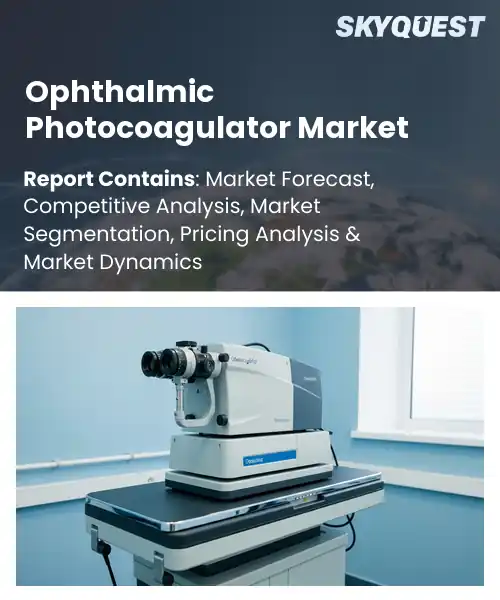
Ophthalmic Photocoagulator Market
Report ID: SQMIG35A3853
Report ID: SQMIG35A3853
sales@skyquestt.com
USA +1 351-333-4748
Report ID:
SQMIG35A3853 |
Region:
Global |
Published Date: June, 2026
Pages:
157
|Tables:
126
|Figures:
77





Global Ophthalmic Photocoagulator Market size was valued at USD 160.20 Million in 2024 and is poised to grow from USD 168.67 Million in 2025 to USD 254.77 Million by 2033, growing at a CAGR of 5.3% during the forecast period (2026-2033).
The primary factors driving ophthalmic photocoagulator market trends are the increase in worldwide incidence of retinal disease and the ongoing technological improvements in laser delivery systems. Photocoagulators, which use laser light energy for specialized treatment of diabetic retinopathy, retinal trauma and age-related macular degeneration, are important because their use creates long-term value through reductions in total health care costs associated with blindness and maximization of patient productivity. Historically, the devices used to treat retinal disease have transitioned from argon and xenon arc lamps to solid-state and diode lasers; for example, the introduction of pattern-scanning photocoagulators has reduced the time required for these treatments and improved patient experience, thus increasing clinicians' application of treatments, which results in greater usage globally. Practically speaking, the use of multi-spot delivery methods increases patient throughput and maximizes treatment planning from a clinical perspective. Therefore, high-volume outpatient centers have the ability to scale their services and enhance their operating margins. At the same time, the use of lower-cost diode photocoagulators will also increase the appeal of these treatments in developing countries.
How is AI Enhancing Precision in the Ophthalmic Photocoagulator Market?
AI is increasing the accuracy of ophthalmic photocoagulator industry by leveraging enhanced image analysis and treatment delivery systems. Automated lesion detection segmentation and image guided targeting are key components that allow clinicians to more accurately identify disease. The current trend is to move from manual spot placement to AI assisted planning, which utilizes suggested treatment maps and dynamically adjusts energy to the physical characteristics of tissue. By doing so, this helps to avoid excess damage to tissue and provides standardised outcomes between clinicians. The growing demand for retinal therapies and desire for tools that assist in improving efficiency and consistency are driving market changes in this direction. Examples include AI assisted lesion mapping and real time OCT integration that provide more predictability in treatment and facilitate teaching.
As stated in Iridex April 2026, they continue to pursue laser photocoagulation and related research, as part of an overall movement in the industry towards precision through AI. AI contributes to improving target selection and consistency in treatments as well as efficiency within workflow; thus, supporting market acceptance and clinician confidence.
Market snapshot - (2026-2033)
Global Market Size
USD 160.2 Million
Largest Segment
Argon Laser Photocoagulators
Fastest Growth
Pattern Scanning Laser Photocoagulators
Growth Rate
5.29% CAGR
To get more insights on this market click here to Request a Free Sample Report
Global ophthalmic photocoagulator market is segmented by product type, technology, application, end user and region. Based on product type, the market is segmented into argon laser photocoagulators, diode laser photocoagulators, Nd:YAG laser photocoagulators, pattern scanning laser photocoagulators, multispot laser photocoagulators and others. Based on technology, the market is segmented into single spot laser systems, pattern scan laser systems, micropulse laser technology and combination laser systems. Based on application, the market is segmented into diabetic retinopathy, retinal detachment, age-related macular degeneration (AMD), glaucoma, retinal vein occlusion and other retinal disorders. Based on end user, the market is segmented into hospitals, ophthalmic clinics, ambulatory surgical centers (ASCs), specialty eye care centers and research & academic institutes. Based on region, the market is segmented into North America, Europe, Asia Pacific, Latin America and Middle East & Africa.
The segment of pattern scanning laser photocoagulators leads the way by delivering numerous, accurately spaced laser spots in extreme speed, thus improving both efficiency and consistency of treatment for patients with retinal diseases. Additionally, Pattern Scanning Laser Photocoagulators have the potential to decrease procedure time, reduce clinician fatigue, improve the reproducibility of lesion placement, and expand the application of this technology to the treatment of diabetic retinopathy and other retinal diseases. The integration of Pattern Scanning Laser Photocoagulators with imaging systems and the active involvement of vendors in the development of these devices also support clinician preference and procurement decisions, emphasizing the importance of these devices in clinical protocols and purchasing cycles.
On the other hand, diode laser photocoagulators represent the fastest growing segment of the market due to their compact size, ease of use and extensive versatility across a variety of clinical settings. The low maintenance and energy-efficient characteristics of Diode Laser Photocoagulators promote their adoption in diverse clinical settings. Continuous advancements in diode laser photocoagulator technology and increased indications for use are opening up new opportunities for fresh procurements and use of diode laser photocoagulators, thereby accelerating and penetrating the workflows of ambulatory and specialty means of doing business.
The microPulse laser technology segment is leading in the use of subthreshold laser delivery to reduce collateral thermal damage while ensuring effective therapy in macular and sensitive retinal applications, this is a consideration related to safety. This subthreshold delivery system has properties that allow for tissue-sparing repeatability, allowing for an increase in the number of clinical indications where conventional continuous wave lasers would have previously presented risk factors, and driving preference from clinicians and consideration from guidelines. Continuing device innovation, as well as accumulating clinical evidence continue to support the adoption of this technology with clinicians using the MicroPulse laser system as part of their standard care pathway due to the increasing confidence associated with these products.
The pattern scan laser system is currently experiencing the highest rate of growth due to the clinic focus on increasing throughput and achieving reproducible treatment patterns through automated spot sequencing and imaging integration. Improvements in clinic efficiency, shorter procedure times by both the vendor and/or physician associated with the Pattern Scan Laser, and improvements in user interface designs and clinical training are driving the adoption of these technologies into high-volume practices, creating an opportunity for investment into complementary technologies.
To get detailed segments analysis, Request a Free Sample Report
Concentration of knowledge, widely embraced by institutions and a high level of integration into clinical practice with advanced pathways in ophthalmology is what gives North America the largest part of the ophthalmic photocoagulator market growth. The presence of extensive referral networks with many specialist clinics and academic centers, as well as established reimbursement structures for the routine use of photocoagulation as part of approved clinical protocols is also a reason for North America to dominate the photocoagulation market. Strong innovation ecosystems providing both product development as well as continuous refinement through iterative testing and evaluation have also created an environment where photocoagulation devices are readily available to patients because of the collaborative nature of both the healthcare providers and manufacturers. Finally, close working relationships between the clinician and the manufacturer, strategic alliances between the manufacturers and their distribution partners along with focused education programs and a comprehensive service infrastructure continue to create leadership in the North American market for photocoagulation and allow for rapid translation of technological advancements arising from research and development into everyday clinical practice.
Ophthalmic photocoagulator market share in United States reflects concentrated demand across specialized ophthalmology centers and integrated health systems. Clinical familiarity with a range of laser platforms and structured training programs support adoption. Close engagement between device manufacturers and key opinion leaders drives iterative product refinement and tailored service models. Reimbursement pathways and institutional procurement practices underpin predictable device selection, while clinical research collaborations foster optimization of treatment protocols and workflow integration.
Ophthalmic photocoagulator market outlook in Canada reflects centralized specialist networks and emphasis on equitable access to advanced ophthalmic therapies. Procurement often follows interprovincial coordination and clinical guideline alignment. Training initiatives and partnerships between tertiary centers and community providers encourage dissemination of laser techniques. Manufacturers work with clinician groups to adapt service models to delivery settings while health system priorities and workforce planning influence utilization patterns and technology adoption across care pathways.
Three key drivers cause rapid growth throughout and will continue to shape the landscape of photocoagulation devices in continental Europe, the modernization of clinical practices; alignment of reimbursement policies between the regions in which photocoagulators and retinal therapies are applied; and the active engagement of both academic and community practices to adopt new technologies. As there is an increased focus on early detection and standardized therapies across the board, relying on established methods of photocoagulation and associated therapies will become increasingly important. In addition, through proper investments made by developers into training clinicians and developing multicenter relationships, there will be greater consistency regarding technical ability when performing photocoagulation procedures, as well as diffusion of best practice procedures. Through the establishment of consortium purchasing agreements and suppliers becoming more actively engaged, fragmented market areas for the purchase of photocoagulators are becoming more harmonized, allowing greater access to photocoagulator devices. Manufacturers are relying heavily on localized service models and providing regulatory services to meet the local needs of the countries where they sell devices and technologies, while the establishment of partnerships between academia and industry is accelerating evidence-based practices and optimally developing technology across high-end and peripheral care settings. Increased patient awareness and the development of cross-border clinical networks will serve to strengthen the alignment of demand and supply for photocoagulators and training resources.
Ophthalmic photocoagulator market forecast in Germany benefits from concentrated care delivery in specialized centers and established clinical research in retinal therapies. Institutional procurement and clinician networks support adoption of refined laser platforms. Manufacturer collaboration with university hospitals fosters device evaluation and training. Aligned clinical guidelines and coordinated specialty networks enable consistent procedural standards. Service and maintenance infrastructure supports device utilization and integration into multidisciplinary ophthalmic care pathways and robust referral networks.
Ophthalmic photocoagulator market penetration in United Kingdom shows accelerated uptake across tertiary centers and community eye services. Emphasis on streamlined care pathways and targeted clinician training supports broader procedural capacity. Collaborative procurement initiatives and investment in service delivery enable rapid scaling of device availability. Manufacturers tailor training and support programs to diversify clinical settings. Strengthened referral frameworks and growing clinician familiarity contribute to intensified integration of photocoagulation into routine retinal care.
Ophthalmic photocoagulator market regional outlook in France is emerging through modernization of ophthalmic services and targeted clinician education. Regional centers promote adoption of refined laser techniques while procurement approaches increase device accessibility. Collaboration between manufacturers and clinical networks facilitates adaptation of equipment to varied care settings. Emphasis on guideline development and training supports standardized practice. Strengthening maintenance and service capabilities underpins integration of photocoagulation across broader ophthalmic care pathways and referral networks.
Asia Pacific will solidify it’s footprint with strategic investments in expanding clinical capacity, building local manufacturing capabilities and increasing specialist training programs. There is an increased emphasis on enhancing access to retinal care in urban and nonurban centers that drives the need for consistent, reliable photocoagulation technologies developed for different practice areas. Collaborative efforts by academic institutions in the region and manufacturers internationally promote the ability to adapt devices to local practice established processes and develop the same expertise with equipment used for the same types of procedures. Increased policy emphasis around service delivery and supply chain management along with expanding equipment maintenance and training networks will enable increased access to evaluation and treatment. Incremental innovations developed by regional companies and their strategic partnerships will also provide additional product availability and clinical support that will allow regions to close the gap in access and consistency in procedures relative to more developed markets. Stronger emphasis of outcome measurement and the development of regional guidelines will also result in more confident clinicians and increased use of services.
Ophthalmic photocoagulator market regional forecast in Japan is supported by advanced clinical infrastructure and strong focus on device innovation. Integration of photocoagulation into comprehensive retinal care pathways is driven by collaboration between specialist centers and manufacturers. Emphasis on clinician training and device servicing underpins high standards of procedural delivery. Local production capabilities and post market support contribute to availability. Partnerships with international firms and academic networks facilitate technology transfer and clinical evaluation.
Ophthalmic photocoagulator industry trends in South Korea is advancing through strong hospital networks and emphasis on clinical excellence in retinal care. Adoption of reliable laser technologies is supported by clinician training and manufacturer collaboration. Service and maintenance ecosystems support device uptime. Local firms contribute through incremental innovation and partnerships that adapt devices to regional practice patterns. Focus on guideline development and coordination underpins broader clinical integration and patient referral networks locally.
To know more about the market opportunities by region and country, click here to
Buy The Complete Report
Increasing Demand For Minimally Invasive Treatments
Technological Advancements In Laser Systems
High Cost Of Advanced Devices
Stringent Regulatory Approval Processes
Request Free Customization of this report to help us to meet your business objectives.
Competitive dynamics in the global ophthalmic photocoagulator market center on technology differentiation, corporate venture investment, and faster product rollouts. Recent examples include ZEISS Ventures backing temperature controlled retinal laser research, Norlase entering with the compact LEAF photocoagulator, and Quantel Medical introducing the Easyret system. Firms pursue partnerships, licensing and selective acquisitions to secure clinical evidence and channel access.
Top Player’s Company Profile
Recent Developments in the Ophthalmic Photocoagulator Market
SkyQuest’s ABIRAW (Advanced Business Intelligence, Research & Analysis Wing) is our Business Information Services team that Collects, Collates, Correlates, and Analyses the Data collected by means of Primary Exploratory Research backed by robust Secondary Desk research. As per SkyQuest analysis, the global ophthalmic photocoagulator market is being driven primarily by rising prevalence of retinal diseases coupled with ongoing technological refinement in laser platforms as a key driver, while a second driver is deeper integration of laser systems with imaging, AI and workflow enhancements that improve precision and throughput. A restraint is the high cost of advanced devices which limits adoption in smaller clinics and emerging markets. The dominating region is North America due to concentrated clinical expertise and mature reimbursement, and the dominating segment is pattern scanning laser photocoagulators thanks to faster multi-spot delivery, reproducible lesion placement and seamless imaging integration that support high-volume outpatient care.
| Report Metric | Details |
|---|---|
| Market size value in 2024 | USD 160.2 Million |
| Market size value in 2033 | USD 254.77 Million |
| Growth Rate | 5.29% |
| Base year | 2024 |
| Forecast period | (2026-2033) |
| Forecast Unit (Value) | USD Million |
| Segments covered |
|
| Regions covered | North America (US, Canada), Europe (Germany, France, United Kingdom, Italy, Spain, Rest of Europe), Asia Pacific (China, India, Japan, Rest of Asia-Pacific), Latin America (Brazil, Rest of Latin America), Middle East & Africa (South Africa, GCC Countries, Rest of MEA) |
| Companies covered |
|
| Customization scope | Free report customization with purchase. Customization includes:-
|
To get a free trial access to our platform which is a one stop solution for all your data requirements for quicker decision making. This platform allows you to compare markets, competitors who are prominent in the market, and mega trends that are influencing the dynamics in the market. Also, get access to detailed SkyQuest exclusive matrix.
Table Of Content
Executive Summary
Market overview
Parent Market Analysis
Market overview
Market size
KEY MARKET INSIGHTS
COVID IMPACT
MARKET DYNAMICS & OUTLOOK
Market Size by Region
KEY COMPANY PROFILES
Methodology
For the Ophthalmic Photocoagulator Market, our research methodology involved a mixture of primary and secondary data sources. Key steps involved in the research process are listed below:
1. Information Procurement: This stage involved the procurement of Market data or related information via primary and secondary sources. The various secondary sources used included various company websites, annual reports, trade databases, and paid databases such as Hoover's, Bloomberg Business, Factiva, and Avention. Our team did 45 primary interactions Globally which included several stakeholders such as manufacturers, customers, key opinion leaders, etc. Overall, information procurement was one of the most extensive stages in our research process.
2. Information Analysis: This step involved triangulation of data through bottom-up and top-down approaches to estimate and validate the total size and future estimate of the Ophthalmic Photocoagulator Market.
3. Report Formulation: The final step entailed the placement of data points in appropriate Market spaces in an attempt to deduce viable conclusions.
4. Validation & Publishing: Validation is the most important step in the process. Validation & re-validation via an intricately designed process helped us finalize data points to be used for final calculations. The final Market estimates and forecasts were then aligned and sent to our panel of industry experts for validation of data. Once the validation was done the report was sent to our Quality Assurance team to ensure adherence to style guides, consistency & design.
Analyst Support
Customization Options
With the given market data, our dedicated team of analysts can offer you the following customization options are available for the Ophthalmic Photocoagulator Market:
Product Analysis: Product matrix, which offers a detailed comparison of the product portfolio of companies.
Regional Analysis: Further analysis of the Ophthalmic Photocoagulator Market for additional countries.
Competitive Analysis: Detailed analysis and profiling of additional Market players & comparative analysis of competitive products.
Go to Market Strategy: Find the high-growth channels to invest your marketing efforts and increase your customer base.
Innovation Mapping: Identify racial solutions and innovation, connected to deep ecosystems of innovators, start-ups, academics, and strategic partners.
Category Intelligence: Customized intelligence that is relevant to their supply Markets will enable them to make smarter sourcing decisions and improve their category management.
Public Company Transcript Analysis: To improve the investment performance by generating new alpha and making better-informed decisions.
Social Media Listening: To analyze the conversations and trends happening not just around your brand, but around your industry as a whole, and use those insights to make better Marketing decisions.
REQUEST FOR SAMPLE
 REQUEST FREE CUSTOMIZATION
Global Ophthalmic Photocoagulator Market size was valued at USD 160.2 Million in 2024 and is poised to grow from USD 168.67 Million in 2025 to USD 254.77 Million by 2033, growing at a CAGR of 5.29% during the forecast period (2026-2033).
Competitive dynamics in the global ophthalmic photocoagulator market center on technology differentiation, corporate venture investment, and faster product rollouts. Recent examples include ZEISS Ventures backing temperature controlled retinal laser research, Norlase entering with the compact LEAF photocoagulator, and Quantel Medical introducing the Easyret system. Firms pursue partnerships, licensing and selective acquisitions to secure clinical evidence and channel access. 'Iridex Corporation', 'Lumenis Ltd.', 'Topcon Corporation', 'NIDEK Co., Ltd.', 'Carl Zeiss Meditec AG', 'Ellex Medical Lasers Limited', 'Quantel Medical', 'Alcon Inc.', 'Bausch + Lomb', 'Johnson & Johnson', 'Haag-Streit Group', 'Optos plc', 'Ziemer Ophthalmic Systems AG', 'Santen Pharmaceutical Co., Ltd.', 'Canon Inc.', 'Heidelberg Engineering GmbH', 'Optotek Medical d.o.o.', 'Gulden Ophthalmics', 'Appasamy Associates', 'Aurolab'
The growing preference for minimally invasive ophthalmic procedures enhances adoption of photocoagulators because clinicians prioritize therapies that reduce patient recovery time, procedural risk, and postoperative complications. Photocoagulation devices are perceived as effective focal treatments that integrate into outpatient workflows and complement other interventions, encouraging hospitals and specialty clinics to invest in such equipment. As clinical pathways evolve toward less invasive options, procurement decisions increasingly favor technologies that support targeted retinal treatments, thereby creating sustained demand and encouraging manufacturers to expand product offerings and service support.
Ai Enhanced Diagnostic Integration: Manufacturers are increasingly integrating photocoagulation platforms with ocular imaging and diagnostic software to enable image guided therapy and streamline clinician workflows. This convergence supports more precise lesion localization, treatment planning, and enhanced documentation, improving confidence in clinical decision making. Interoperability with electronic records and telemedicine tools facilitates collaborative care and remote consultations, while vendor partnerships with imaging providers accelerate feature development, positioning combined imaging treatment systems as a value proposition for providers seeking efficiency, consistency, and improved patient communication experience.
Why does North America Dominate the Global Ophthalmic Photocoagulator Market? |@12










































Want to customize this report? This report can be personalized according to your needs. Our analysts and industry experts will work directly with you to understand your requirements and provide you with customized data in a short amount of time. We offer $1000 worth of FREE customization at the time of purchase.
Feedback From Our Clients


 USA (+1) 351-333-4748